
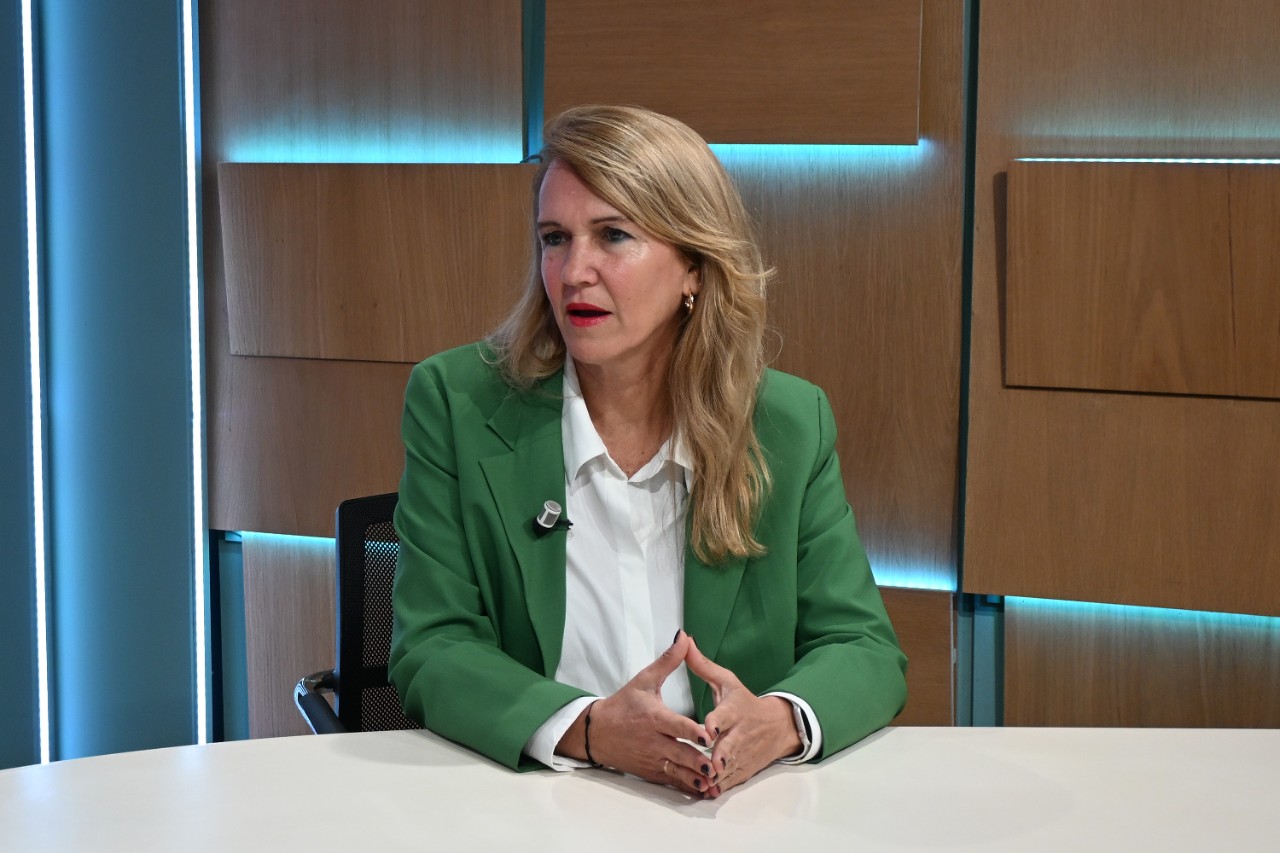
“We have a Vocational Training (FP) that is thinking about the labor market, our young people, our people to be able to certify their experience and be able to enter the labor market practically immediately and, in addition, taking into account what is the productive fabric of Melilla, what our city needs”
The Provincial Director of the Ministry of Education, Vocational Training and Sports (MEFPyD) in Melilla, Elena Fernández Treviño, has highlighted in the program El Inicio de Televisión Melilla the growth that Vocational Training has experienced in the city and the job opportunities it is generating.
The head of the Provincial Directorate stressed that the FP “is offering a lot of professional opportunities”, remembering that the city has reached 30 training cycles between basic, middle and higher grades, distributed in the Secondary Schools and in the Queen Victoria Eugenia Integrated Center. This offer has recently been joined by professional certificates, “a very interesting tool” that has been opened both in the institutes and in the integrated center itself.
In total, Melilla has launched nine professional certificates aimed at both people with previous experience and those who want to train for a period ranging from two to six months, with the aim of improving their job placement.
The Provincial Director explained that according to the latest professional integration report, the upward trend is confirmed. “We are talking about a very high insertion rate,” he said.
The new professional certificates have covered very diverse areas, from pastry and pastry to socorrism, vehicle painting, storage or pest control, all of them “very useful for professional life”, he said.
Fernández Treviño has given concrete examples, such as the certificate of socorrismo, which if done before the summer allows work during the summer season, or those of pastry and pastry, very demanded by the local hospitality industry. He has also insisted that the Melillense FP has been designed according to the productive fabric of the city. To this end, the Administration has met with employers, the SEPE, trade unions and other agents in order to draw up a needs map that has guided the annual offer.
The Provincial Director stressed that Vocational Training “has grown a barbarity”, as the number of cycles offered, the number of students and the teaching staff has multiplied by two and a half. This increase has meant new hires that have been added to the already strengthened staffing tables. “We can take advantage of this,” he said, “because we have reached historic figures for hiring teachers, without a doubt.”
More teaching staff than ever
“We have, along with the lowest pupil/classroom ratios, the highest number of teachers we have had in history.” During the interview, Fernández Treviño highlighted the progress made in recent years in reducing school ratios and incorporating new human resources into the city’s education system.
Thus, he explained that the Infant and Primary cycles comply with the law, being between 20 and 25 students per class, while recalling that in the past figures were reached “of 30 and many”, a scenario that has managed to reverse.
In addition, although more groups persist in the higher courses of ESO and Baccalaureate, it has progressed that will tend to decrease in the coming years, aligning itself with the commitment of the Government of Spain to comply with the ratios established by law.
The head of the Provincial Directorate of Education has also highlighted the implementation of innovative programs aimed at strengthening student learning. These include the Territorial Cooperation Programs for Language and Mathematics, which have allowed additional teachers to be assigned to both primary and secondary schools.
This reinforcement facilitates co-teaching, a methodology that involves not only the presence of two teachers in the classroom, but also a new form of coordination and pedagogical planning. “We are training these teachers in co-teaching so that the attention to the students is coordinated and individualized,” he said.
Fernández Treviño recalled that Melilla currently has “the highest number of teachers in history”, as a result of the sum of different initiatives: the incorporation of 300 additional teachers after the pandemic, the allocation of extra quotas through the Territorial Cooperation Programs, the teachers hired through PROA+ and the increase of specialists linked to inclusion measures. To this will be added in January the launch of the new educational compensation program, which will also bring new additions.
However, far from falling into triumphalism, it has recognized that the educational system has undergone profound changes in the last decade and that schools need to adapt to their new reality. In this regard, he has pointed out that the management teams demand more work personnel, such as caregivers or Early Childhood Education technicians, profiles that are also gradually being incorporated.
“We need an entire tribe educating,” he said, insisting that all the people who work in the centers are essential to accompany the students and meet the diversity of needs present in the schools and institutes of the city.