
The BIC declaration of these properties is the highest category of protection established by Law 16/1985, of June 25, of Spanish Historical Heritage
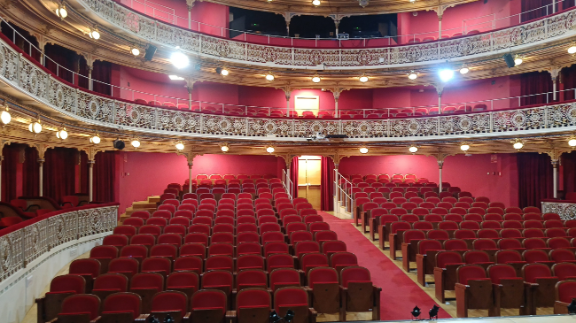
The Theatre of Comedy, the current venue of the National Classical Theatre Company of the National Institute of Performing Arts and Music (INAEM), is a clear example of Madrid’s iron architecture
The National Music Auditorium, inaugurated in 1988, is one of the main centers of creation and musical representation in the country and is the headquarters of the National Orchestra and Choir of Spain, the Young National Orchestra and the National Center for Musical Diffusion
The Council of Ministers, on the proposal of the Minister of Culture, Ernest Urtasun, this morning approved the declaration as Goods of Cultural Interest (BIC) in the category of Monument of the Theatre of Comedy and the building of the National Music Auditorium, both in Madrid. This implies the application of this category of protection, the maximum established by Law 16/1985, of June 25, on Spanish Historical Heritage.
The processing of the files to obtain this declaration began last July, in the case of the National Auditorium, and in the month of September, the Theatre of Comedy.
Theatre of Comedy, an example of iron architecture
El Teatro de la Comedia de Madrid es obra del arquitecto Agustín Ortiz de Villajos. Currently, it houses the headquarters of the National Company of Classical Theatre, dependent on the National Institute of Performing Arts and Music (INAEM), an autonomous state body dependent on the Ministry of Culture.
The building responds to the style of the nineteenth-century theatres, with a sober design and a façade of classical inspiration. Its most significant dependence is the main hall of the theater, in the shape of a horseshoe, wooden stage and ceiling with paintings by José Vallejo and Galeazo representing a transparent sky with trompe-l’oeil of Arab architectures in its pechins.
Ortiz de Villajos decided to use iron in its structure and decoration, making it an emblematic example of Madrid’s iron architecture.
History
The Theatre of Comedy was inaugurated on September 18, 1875, 150 years ago, on Príncipe Street in Madrid, in the Barrio de las Letras. Its origins are in the coliseum that the businessman of rooms and parties Silverio López Larrainza wanted to build on the plot of a courtyard of neighbors of his property, located on Calle del Príncipe 14 and Calle Núñez de Arce.
The works began in 1873 and Tirso García Escudero de la Torre was its sole owner from the 1896-97 season until his death in 1950. In its tables were celebrated the premieres of the classics of the Golden Age and of authors such as Jacinto Benavente, Benito Pérez Galdós, the brothers Álvarez Quintero or Leandro Fernández de Moratín.
In 1915, a fire destroyed the interior of the theater and the room was rebuilt in a few months by the architects Luis Bellido and José López Sallaberry. Since then it continued its activity, which was interrupted during the Civil War.
At the time of the 70s, independent social and political performances were represented in it, such as ‘Castañuela 70’, ‘Yerma’ or ‘Sócrates’. In his stage, the first nude of the Spanish theater was shown during the Franco era, with the play ‘Equus’.
In 1998, the Ministry of Culture purchased the theater and acquired five of the floors of the building to consolidate the Comedy Theater as the stable headquarters of the National Classical Theater Company. In 2002 the Comedy was closed to the public to undergo extensive reform, and reopened in 2015.
National Music Auditorium
The National Music Auditorium was inaugurated in 1988 and, from the moment of its opening, it is one of the main centers of creation and musical representation of the country.
Its construction was carried out by the renowned architect José María García de Paredes, who already had a great experience in the design of musical infrastructures. German engineers Lothar Cremer and Thomas Fütherer of the Berlin Institute of Acoustics advised the project.
The design of the building is a continuation of the architectural identity of García de Paredes, which stands out for its simplicity and the serene urban implementation of its buildings. The exterior runs parallel to Príncipe de Vergara Street, with facades of uniform rhythms that correspond to the perimeter galleries that run through the building, treated as a flat and continuous surface.
Inside, the building is organized into three independent bodies, separated by structural expansion joints. At the north end is the Symphony Hall, in the south the Chamber Hall and in the center the General Service Corps. To isolate the rooms from noise, in addition to their arrangement in the building, a system of double doors with deep exclusives is used, which must be crossed before entering them.
The architect calculated to the millimetre the acoustics of the rooms, following the theoretical foundations of musical architecture, taking into account the volume of air inside the rooms in relation to the number of spectators and the maximum width of the same. Its design prioritizes the sound quality, which influences the selection and location of each seat, and is completed with the walnut wood cover that runs through the two rooms.
Origin
Until the moment of its inauguration, the symphonic concerts of the city of Madrid were performed at the Teatro Real. In 1969, the rehabilitation of the Teatro Real as the Teatro de la Ópera was proposed to adjust it to its original functionality, so the need to provide the city with a concert hall was evidenced.
The project began in 1983 within the framework of the National Auditorium Plan, aimed at providing the country with an adequate musical infrastructure consistent with the needs of the society of the moment.
At present, the National Auditorium retains its relevance in the music scene, regularly hosting representations of figures of international stature and of the classical repertoire. In addition, it houses the headquarters of the National Orchestra and Choir of Spain, the Young National Orchestra of Spain and the National Center for Musical Diffusion.