
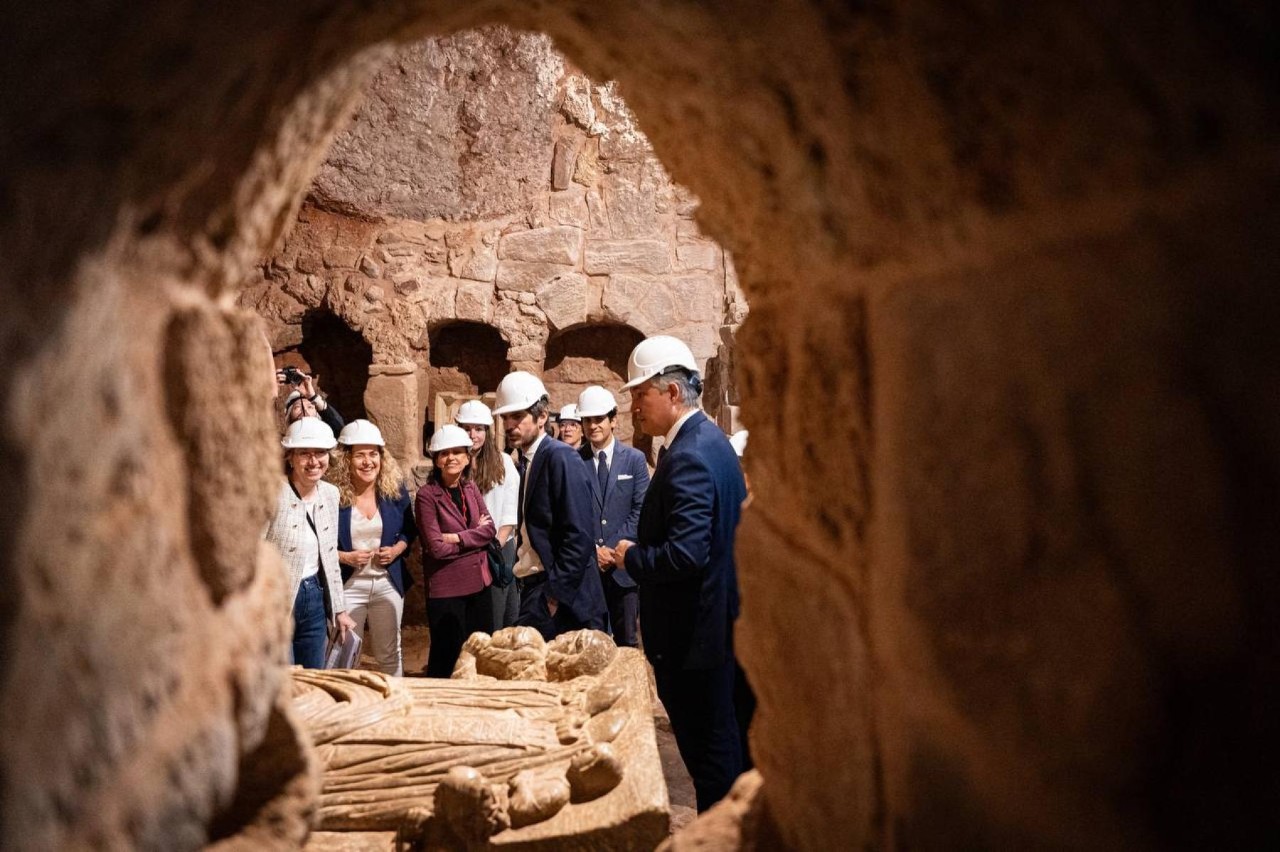
The Minister of Culture, Ernest Urtasun, visited this morning together with the Minister of Culture, Tourism, Sport and Youth of La Rioja, José Luis Pérez, the advance of the emergency works of the Monastery of Suso, in San Millán de la Cogolla (La Rioja), which began last December 2024. The project, provided by the Ministry of Culture with an investment of 4,515,954 euros, and with an expected implementation period of 24 months, is being carried out by the Institute of Cultural Heritage of Spain (IPCE).
The Minister of Culture, Ernest Urtasun, said that this investment “demonstrates our commitment to the Community of La Rioja to protect its heritage, which is key to understanding the history of our language and our country.” In addition, he said that, thanks to these works, “future generations will be able to continue enjoying the Suso Monastery, which is a unique place and a fundamental symbol of our cultural identity.”
Urtasun has also presented the program ‘Open for restoration’ that will be offered, between the months of June and September, to visitors of this important monument as an alternative to the usual tourist visits, which had been temporarily suspended due to the works.
The guided tours, 50 minutes long and free, will take place every Saturday from June 14 to September 14, in two hours (11 hours and 13 hours), and will have a capacity limited to 20 people. The registration form will soon be available on the IPCE website.
The program provides a guided tour through the interior of the building, as well as access to the scaffold turret enabled for tourist visits with the aim of understanding the scope of the implementation of the auxiliary means and the development of studies to expand knowledge about the history and conservation of the monument.
Emergency works to ensure tightness and stability
The intervention in execution was declared emergency by the Council of Ministers in December 2024 due to the current structural instability of the building. This, together with the persistent water leaks, increased by the torrential rains that occurred in La Rioja last autumn, compromise the structural integrity of the monastic group, declared a World Heritage Site by UNESCO in 1997, and considered as the cradle of the Castilian language.
The works are focused on a double objective: on the one hand, on the elimination of the building’s sources of moisture and the diversion of the surface water from the environment to achieve adequate indoor environmental conditions; and on the other, on the structural consolidation of the building and the land on which it sits and adosa.
In order to protect the building from water leaks during the course of the work, a temporary cover has been installed that will be removed once the tightness of the assembly is guaranteed. The works will involve acting on the roofs of the set and other constructive elements affected by pathological processes, with special attention to the active structural movements present in the wall, arch and sole structures.
Given the nature of the property affected, all the actions will be based on a deep knowledge of the building, including the development of non-invasive diagnostic tests, monitoring of structural movements, historical and archaeological research, and characterization of materials, among others. These studies will be added to those carried out by the IPCE so far: a photogrammetric survey of the building and a geophysical and geological study of the environment.
Monasteries of Suso and Yuso
The Suso Monastery, founded in Visigothic times by the hermit San Millán, was the origin of one of the first Hispanic monastic communities and became an important religious, cultural and linguistic center. Expanded in Mozarabic and later Romanesque style, it wrote important medieval texts such as the Emilian glosses, which mark the birth of the Spanish language. Although its difficult location motivated the construction of the Monastery of Yuso, Suso remained a place of study and retreat, and was also the cradle of the first poet known in Castilian language, Gonzalo de Berceo.
The monastic ensemble of San Millán de la Cogolla, formed by the Monasteries of Suso and Yuso, was declared a World Heritage Site by UNESCO in 1997, and stands out for its religious and cultural impact in La Rioja and Navarra, and its link with the origin of monastic life in Spain and the Castilian language.