Salvamento Marítima, a subsidiary of the Ministry of Transport and Sustainable Mobility through the General Directorate of the Merchant Navy, successfully concluded last June a submarine operation to supervise the oil tanker Woodford, which has been sunk off the coast of Castellón since 1937.
The wreck is at an important depth of 80 meters, which makes submarine operations considerably difficult. As early as 2012, Salvamento Maritimo performed an unprecedented operation to examine the wreck and extract a large amount of fuel (450 cubic meters of hydrocarbon) from it.
“The aim of this recent operation was to check the condition of the wreck more than a decade after our first intervention”, says Rafael Bautista, head of the Special Operations and Pollution Control Service at Salvamento Maritimo. The tests carried out by Salvamento Maritimo have confirmed that there are no leaks of fuel and that, if there are losses, they are residual.
Phases of the recent operation
Last June, the Special Maritime Rescue Operations team, headed by Rafael Bautista, returned to the site of the sinking to carry out a reconnaissance inspection and check the condition of the wreck. In the operation, divided into four phases, two dives were performed with a remote control underwater inspection vehicle (ROV).
In the first immersion of the ROV, on Wednesday, June 18, a first phase of general recognition around the vessel, checking whether there were fishing nets, ropes or tangled cables that could pose a danger of entrapment to the ROV vehicle itself. Once the absence of hazardous elements was verified, it was moved to one second phase, in which the main deck of the vessel was inspected in detail. Thus, the bow castle, the command bridge, the port side of the main deck and the stern part were checked, reaching as far as the propeller and the rudder. Throughout this previous inspection phase, no hydrocarbon leakage from the wreck was detected.
The next day, with calm sea, the second immersion began in which the following phases were carried out: third phase It consisted of trying to locate the blind flanges or caps, which were placed in the holes made in the hull to be able to extract the hydrocarbon in the operations of 2012. “The vegetation and life on the wreck has grown a lot in recent years and has covered the flanges. We were able to locate those of tanks 8 and 9 babor, completely camouflaged by the sediment deposited on them. We were watching them and checking that they were intact and there was no escape.”, explains the head of the Special Operations and Pollution Control (LCC) area of Salvamento Maritimo, Juan Ferrer, coordinator of the Operation.
Finally, the fourth phase It consisted of a more detailed inspection of the ship’s hull by the side of Babor, especially in the central area, where the 9 cargo tanks are located. If there had been a leak, it would probably have been located here, as this is where the ship’s fuel cargo was stored. “We did not manage to locate any leaks, which is a good sign, and makes us suppose that the losses that the wreck may have are residual, of the remains that may remain among the reinforcements of the tanks”, says Ferrer. At the end of the hull inspection, the Special Maritime Rescue Operations team revisited the main deck, where they inspected the different tank tops, deck elements, the remains of the two masts, and, already at the stern, the ship’s chimney.
Means used
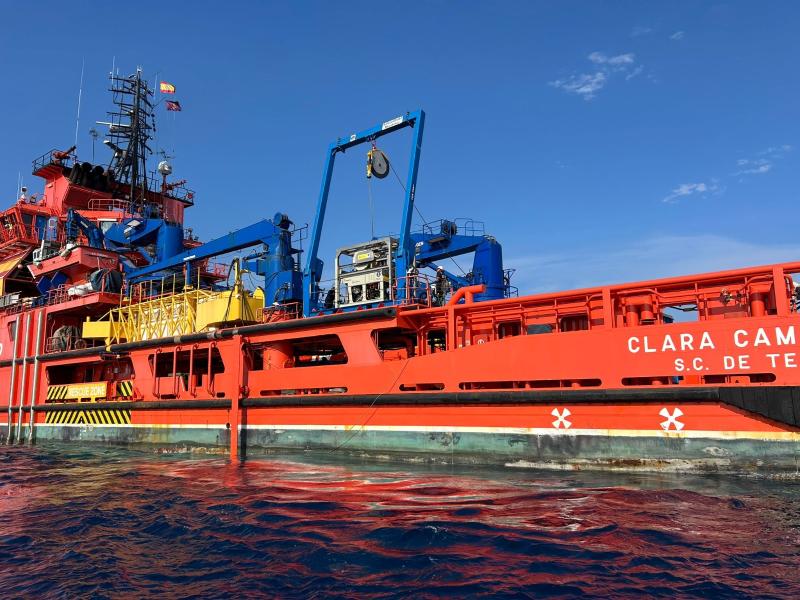
To work in this operation, we have counted on highly qualified professionals, high reliability equipment and a specialized support vessel. All media belong to the Public Administration.
- Multipurpose Marine Rescue Vessel, Clara Campoamor (80 m. length), prepared to house diving equipment and the remote control underwater inspection vehicle (ROV) and serve as a support vessel. This ship, which is usually destined in the Mediterranean, has a great capacity to fight pollution, thanks to its equipment for collecting hydrocarbons through floating arms, barriers and “skimmers” (hydrocarbon suction pumps at sea).
- A Remote Control Underwater Inspection Vehicle (ROV). With cameras, sonar and hydraulic arms that allow you to carry out inspection, search and rescue work at great depths, up to approximately 1000 m.
- Special Operations Team and LCC of Maritime Rescue, with the Head of Service Rafael Bautista in charge of the operation, the Head of Area Juan Ferrer as coordinator of the operation and the superior technicians, Vicente Cobelo as operations technician of the ROV and Luis González as support technician. In addition to the ACSM team of pilots and technicians of the ROV.
Next documentary premiere
This is the second time that Salvamento Maritime has carried out an immersion to assess the state of Woodford. In 2012, Salvamento Marítima carried out an unprecedented operation that has given rise to a documentary that will soon be premiered in Castellón.
This documentary describes how, after carrying out for three years various monitoring and inspection tasks in the sinking area, both submarine and surface, in which it was found that the ship was the source of periodic episodes of pollution by hydrocarbon spillage detected in the area, an operation was carried out, by Salvamento Maritimo, in which using techniques of diving to saturation, it extracted a large amount of fuel that remained inside the cellars, a total of 450 cubic meters distributed in the different tanks.
History of Woodford
On September 1, 1937, in the midst of the Civil War, the English oil tanker Woodford, 130 meters long, sank 40 miles from Castellón after being hit by two torpedoes from the Italian submarine Diaspro, which impacted by the starboard band in the middle section of the ship, causing its sinking about 15 miles north of the Columbretes islands. It remained there for more than 70 years, resting on its starboard side, on a bottom of more than 80 meters, until in 2009, after fishermen warned that there was an odor of oil in the area, it began with the operation that located the wreck and began the “Operation Woodford”.