
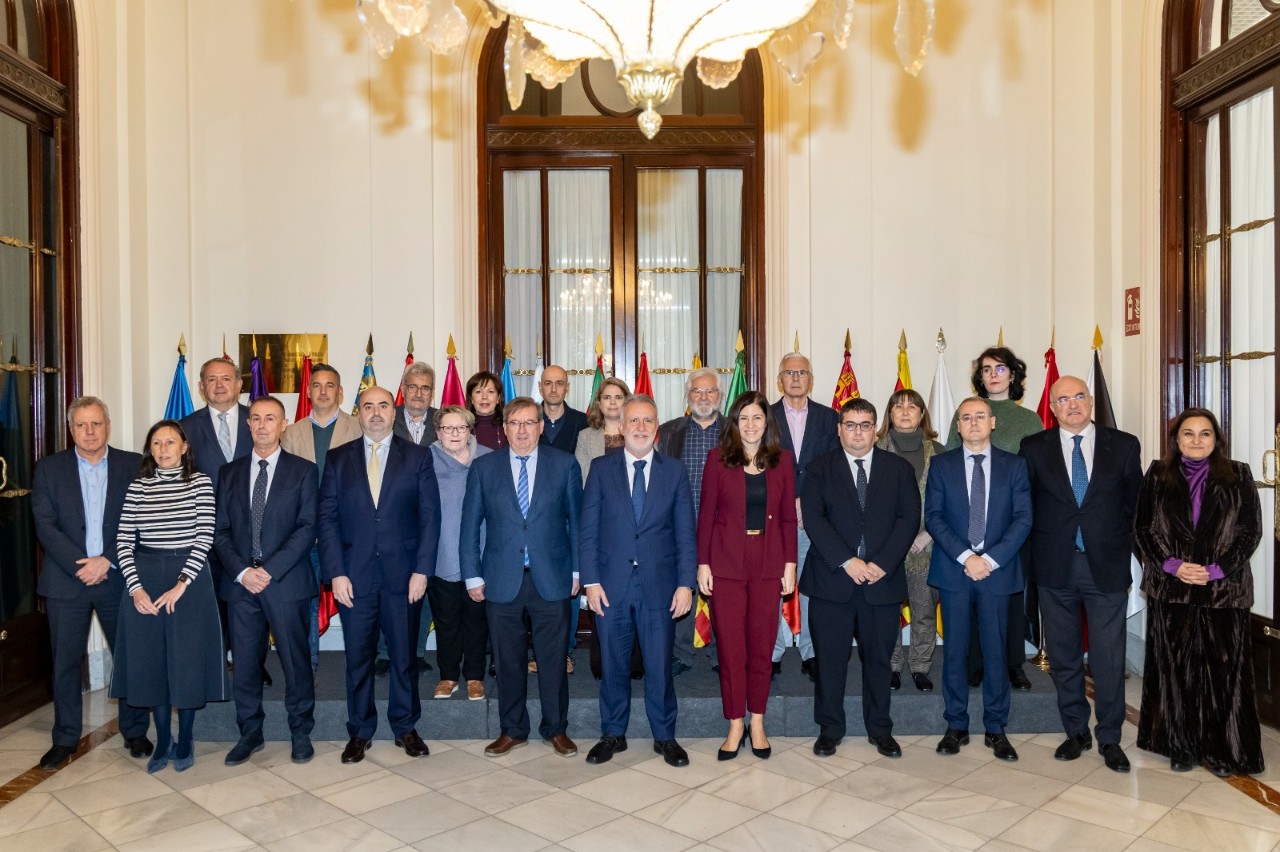
The Minister of Territorial Policy and Democratic Memory, Ángel Víctor Torres, has today presided over the constitution of the Council of Democratic Memory, a collegiate consultative and participatory body of memorialist entities, attached to the Ministry of Territorial Policy and Democratic Memory.
This Council, which implements the Democratic Memory Act of 2022, is responsible for reporting on the draft Democratic Memory Plan, reporting on the multiannual plan for the search, tracing, exhumation and identification and monitoring and evaluation of the plan, reporting on proposals for regulatory provisions related to the development of the Act, preparing reports and recommendations on the policy of democratic memory and assessing and giving opinions on measures that contribute to the achievement of the objectives of the Democratic Memory Act through the action of memory entities, as well as on the subsidies and aid that the General State Administration (AGE) annually convenes for these purposes.
Minister Torres thanked all the members for their work and their willingness to “spread the value of Democratic Memory, the dignity of the victims and provide guarantees of non-repetition. It is essential that society knows how democracy was achieved and that the rights we enjoy today are valued in the face of the dictatorship that plunged us 40 years into a totalitarian regime and an absence of freedoms.”
For the fulfilment of their functions, the members of the Council, who will not receive any remuneration for the exercise of their functions or for attending meetings, will be able to access archives and documentary funds, both public and private, in accordance with current regulations.
The Council is chaired by the head of the Ministry of Territorial Policy and Democratic Memory, with the functions of convening meetings; setting the agenda, taking into account, where appropriate, the requests of other members; chairing the meetings and moderating the conduct of the debates; deciding with his vote the draws, for the purpose of adopting agreements; and ensuring compliance with the laws and checking the minutes and certifications of the meetings.
The Council shall meet on an ordinary basis twice a year and on an extraordinary basis when convened by the Presidency on its own initiative or at the request of one third of the members of the Council.
Powers and duties of the persons making up the Council
It belongs to the people who make up the Council (ANNEX), among other functions, to receive the invitation with the agenda and the information on the topics to be debated; to request the inclusion of matters on the agenda; to participate in the debates of the sessions; to exercise your right to vote and to formulate your particular vote, as well as to express the meaning of your vote.
Commission on Human Rights Violations in War and Dictatorship
The Commission on Human Rights Violations during War and Dictatorship will be established within the Council. Its purpose will be to contribute to the clarification of human rights violations during War and Dictatorship, as a way to promote democratic coexistence, through the receipt of testimonies, information and the collection of documents and other background that allow, with objectivity and impartiality, the elaboration of conclusions and recommendations for the reparation of victims and to prevent such events from happening again in the future.
The Commission shall be composed of a maximum of ten independent persons of recognised standing in the academic or professional world and in the field of human rights. Its appointment is the responsibility of the Council, by agreement adopted by a majority of at least three fifths. In their choice, they must take into account profiles of proven professional solvency in academic, legal and scientific fields, as well as the principle of balanced presence of women and men, except for well-founded and objective reasons, duly motivated.
In the same agreement, the Council will designate, from among the members of the Commission, the person holding the Presidency, who will coordinate the actions of all the members of the Commission.
The Commission shall carry out its duties within eighteen months of its establishment, with the delivery of its report containing the conclusions and recommendations, on which date the term of office of its members shall end.