
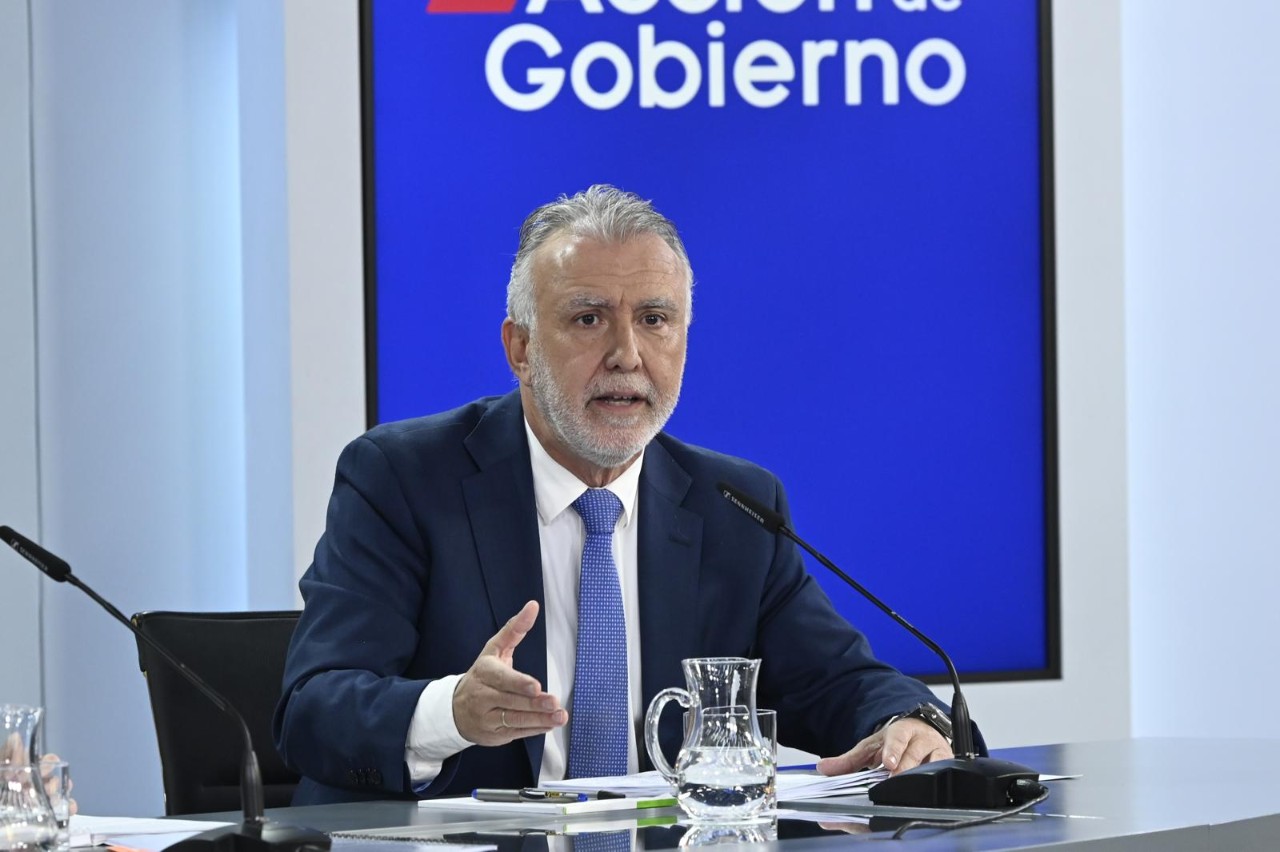
The Minister of Territorial Policy and Democratic Memory, Ángel Víctor Torres, presented today, in the Council of Ministers, an assessment of the three years of Law 20/2022, of October 19, on Democratic Memory. Torres has explained that, in this period of progressive governments, almost 9,000 bodies have been exhumed, and 1,614 declarations of recognition and reparation have been given to the victims of the War and the dictatorship.
The minister also indicated that, thanks to the Democratic Memory Law, the initiatives of some communities such as Aragón, Comunitat Valenciana, Cantabria or Extremadura, Illes Balears and Castilla y León, which sought to repeal the autonomous memory laws, have been paralyzed. “These new rules, in some autonomies, hinder the reparation of victims,” he said, while stressing that it was the UN rapporteurs themselves who argued that the so-called Concordia laws “violate international law.”
Torres has highlighted that, with the extinct I Exhumation Plan and the implementation of the II Exhumation Plan (2025-2028), more than 700 performances have been performed and 8,941 bodies have been recovered. “This figure represents almost half of the 20,000 that are likely to be exhumed, according to a study carried out in 2019 by the Aranzadi Society,” said the minister, who hopes to reach 100% of the work in the remaining term.
The minister has also highlighted the progress of the tasks that are being carried out in the Cuelgamuros Valley. In the crypts works a scientific and multidisciplinary team, for the exhumation and identification of 206 victims, whose families have requested their location, under the Law. So far, 36 boxes with 458 remains have been found; and the scientific team has been able to identify, with DNA evidence, a total of 21 victims.
Another aspect of which the minister has reported is the implementation of the State Bank of DNA of Victims of War and Dictatorship, which already has management software and whose laboratories have been accredited by the National Commission for the Forensic Use of DNA.
In addition, he has placed the accent on the Integrated Map of Fosas, which has just been presented together with Radio Televisión Española. It is an interactive multimedia version that collects the geolocated location of the graves of the Spanish War (1936-1939) and the Franco dictatorship, as well as the victims buried in them, with audiovisual and informative material of each grave.
The minister wanted to highlight the impetus given by the Government of Spain to the resignificance of the Valley of Cuelgamuros, with the call for an international contest of ideas, which has fallen on the project ‘The base and the cross’. “It’s about knowing what happened, reflecting as a society and, especially the youngest, understanding what it means to live in totalitarianism and appreciating the democracy they enjoy,” he added.
Reparation to victims and granting of nationalities
Another aspect promoted in these three years has been the repair. So far, 1,614 declarations of recognition and personal reparation have been granted to victims, which contain three fundamental elements: the consideration of “victim”, the declaration in his case of the illegal and illegitimate nature of the court he condemned and the nullity and illegality of the sentence they imposed.
In addition, public acts of tribute and recognition of the character of victim, of his dignity, name and honor have been carried out, with more than 600 recognitions.
But the recognition is also expressed in the process that ended on October 22 to grant nationality to the descendants of the victims who had to go into exile in other countries. As of July 31, 2025, 876,321 applications had been registered, of which 47% had already approved the procedure and only 0.5% had been denied, the rest being then in the process of processing. At that time, 414,000 had already recognized the right and 237,145 had already been registered with Spanish nationality.
In addition, on November 4, the Royal Decree was approved, granting Spanish nationality by letter of nature to the descendants of the volunteer members of the International Brigades, specifically 54 children and 117 grandchildren of international brigadiers, men and women who voluntarily arrived in Spain to defend the republican legality against the military coup of 1936.
Places of Memory
The Government of Spain has also placed the accent on the declaration as Places of Memory of spaces especially symbolic for their role in history and in repression during the War and the dictatorship. So far 16 have been declared.
In addition to the three declared ex lege by the Democratic Memory Law (Documentary Center of Historical Memory in Salamanca, Valle de Cuelgamuros and Pantheon of Spain), those declared later: ten emblematic buildings linked to Spanish liberalism in the 19th century (in one of them, the Monument to the Martyrs of Freedom ‘Los Coloraos’, in Almería, have been deposited the remains recovered from the coloraos at the foot of the monument, from where they had been removed in 1943); the Urban Center of Gernika-Lumo; the exodus, persecution and massacre of the civilian population of Almeria. In addition, the 18 that have been initiated are provisionally registered and the procedure for their declaration is currently being processed.
Signs and plaques have also been established at five Memorial Sites abroad, such as the Spanish Athenaeum in Mexico, the Garden of the Nine in Paris, the concentration camps of Ravensbruck and Argélès-sur-Mer, and the tombs of Antonio Machado in Colliure and Manuel Azaña in Montauban.
The minister has acknowledged that he cannot understand how “there are those who do not want us to declare places of memory or to resignify spaces that are the memory of repression during the War and the dictatorship. All Democrats should agree on that.”
50 years of Freedom
During this year, the events commemorating the ‘50 years of freedom’ have been taking place, with a large number of actions and activities aimed at paying tribute to those who defended democracy and to transmit to the youngest ones where the freedoms they now enjoy come from. The minister stressed that the events will continue beyond 2025, with 400 new activities.