
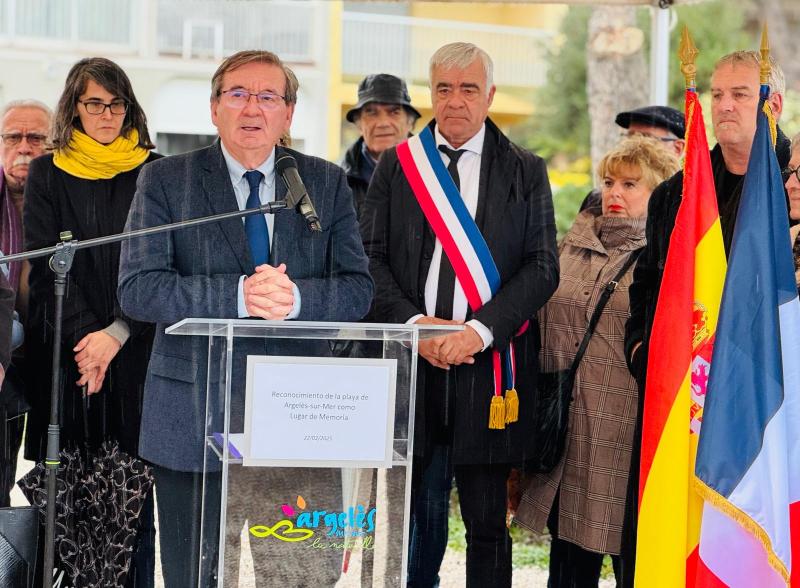
“The European Democratic Memory is not understood without the participation of the Spanish in the defense of freedom, something that fills us with pride, and recognizes, once again, the great contribution of the exiled Spanish republicans in the democratic reconstruction of Europe after the Second World War,” said the Secretary of State for Democratic Memory, Fernando Martínez, who has been accompanied by Carmina Gustrán, commissioner for the celebration of ‘Spain in Freedom. 50 years’, by the consul of Perpignan, Marcelino Cabanas, and by the mayor of Argelès-sur-Mer, Antoine Parra.
The Democratic Memory Law establishes as a Place of Democratic Memory that space, real estate, place or cultural heritage that is immaterial or intangible in which events of singular relevance have been developed for their historical, symbolic significance or for their repercussions on collective memory, linked to democratic memory, the struggle of the Spanish citizens for their rights and freedoms, the memory of women, as well as with the repression and violence on the population as a result of the resistance to the coup d’état of July 1936, the War, the Dictatorship, exile and the struggle for the recovery and deepening of democratic values.
Accompanied by the mayor of Argelés-sur-Mer, the Secretary of State for Democratic Memory has made a floral offering before the memorial that recalls the sufferings of the Spanish Republicans interned in this site, which was the first large concentration camp created in France to house the exiles who had fled the war and the repression of the Franco army.
Fernando Martínez recalled that “between 1939 and 1940 more than 80,000 Spanish republicans, military and civilians, were interned in this camp that was located on the same beach of Argelès-sur-Mer in very difficult and complicated circumstances. They were Spaniards who fought against fascism in Spain and, a few months later, they fought against Nazism in Europe,” he said.