
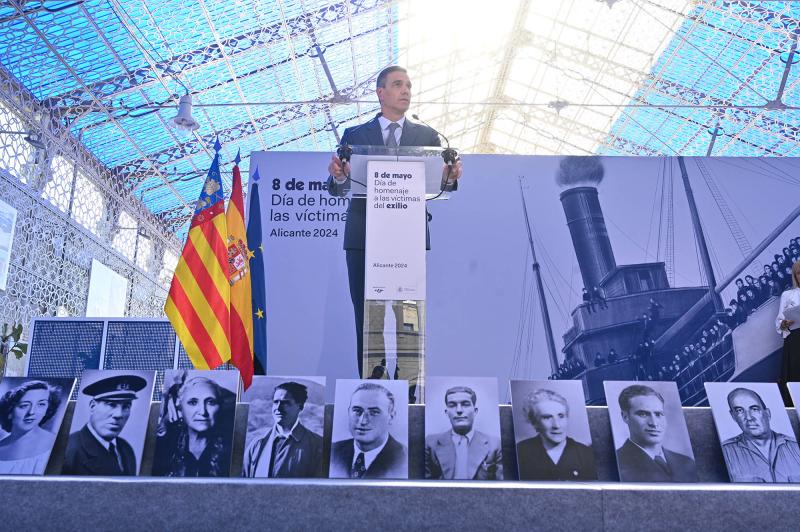
The President of the Government has been accompanied by the Minister of Territorial Policy and Democratic Memory, Ángel Víctor Torres, the Minister of Science, Innovation and Universities, Diana Morant, and the Secretary of State for Democratic Memory, Fernando Martínez, in this act on the occasion of May 8, date established by the Law of Democratic Memory as "a day of remembrance and tribute to the men and women who suffered exile as a result of the War and Dictatorship", coinciding with the victory of the allied troops over the Nazis and fascists that put an end to the Second World War.
"Defending our memory is an obligation derived from our international commitments assumed by Spanish democracy," said the head of the Executive, who denounced that "the anti-memory laws promoted by two political parties of our parliamentary arch in several communities, including the Valencian Community, are an attack on international law, an attack against our democracy and against the dignity of the victims."
In this regard, he pointed out that "as one of the UN rapporteurs said in his report on these rules agreed by the PP and Vox, it is necessary to be a bad person in order not to meet the claims of the victims of what were human rights violations during the Spanish Civil War and the Franco dictatorship." "Because pain never prescribes," he said.
Finally, Sanchez recalled that "in these times of negationism and memory that travel through Europe and the world, those anonymous people who fight against tyranny and barbarity are examples of dignity and resistance", so "today, more than ever, we persist in our duty to remember and to give truth, justice and reparation". "We can, we must, and we will continue to do so, preserve his memory. For their dignity and for our dignity. For the respect of the truth, and what requires the defense of our democratic values, embodied in our Constitution and that we, with the law of Democratic Memory, once again, here claim ", has concluded.