
CSIC Institute of Physical Chemistry Blas Cabrera, Madrid (Spain)
The Higher Council of Scientific Research (CSIC) has carried out a tribute to the scientists who saw their academic career truncated by the coup d'état of 1936, the war in Spain and the purification carried out by the Dictatorship.
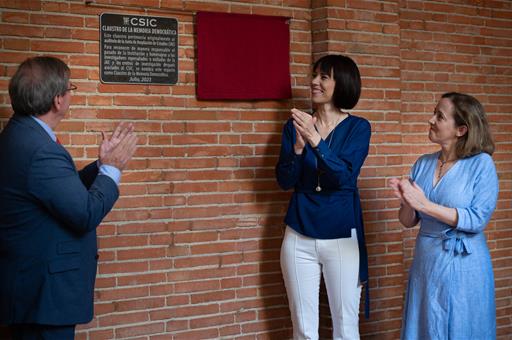
The event was held at the renowned "Claustro de la Memoria Democrática" of the CSIC, in Madrid, with the presence of the Minister of Science and Innovation, Diana Morant, and the Secretary of State for Democratic Memory, Fernando Martínez. In the words of the President of the Higher Council of Scientific Research, Eloisa del Pino, "we celebrate an act of justice but above all we want to remember the joy, the courage and the scientific nerve of that time that some have defined as the "Silver Age" of Spanish science". With this act, insisted Del Pino, "we want to recover the scientific history and strengthen the current democracy remembering a time when research was in full effervescence thanks to the JAE (Board for the Expansion of Scientific Studies and Research)." The JAE, whose first president was the Spanish Nobel Prize winner Santiago Ramón y Cajal, was created in 1907 and dismantled at the end of the War. It constituted the germ of the CSIC.
Under the Democratic Memory Law approved in October 2022, the CSIC has changed the name of the Rocasolano Institute, a Franco censor who presided over the purification courts, to the Blas Cabrera Institute of Chemical Physics, a scientist refined by the Franco regime and has reconverted the cloister of the former library of the JAE into the "Cloister of Democratic Memory" among other initiatives linked to the duty of memory.
Authorities, members of the CSIC and relatives of investigative personnel of the retaliated JAE participated in the various acts of tribute that were carried out in different spaces of the CSIC.