
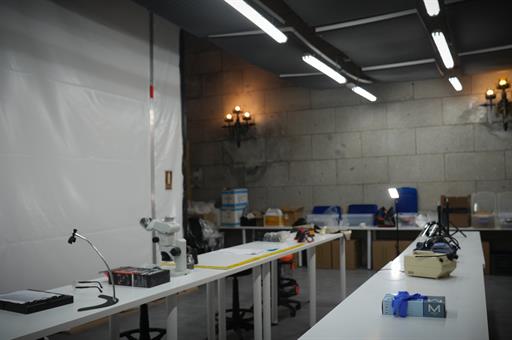
Cuelgamuros Valley, Madrid (Spain)
Work to exhume, at the request of their families, the remains of 128 war victims has resumed in the Cuelgamuros Valley. The resumption comes after the paralysis caused by the precautionary measures imposed by Court No. 10 of Madrid before the various appeals filed.
Once the precautionary measures were lifted by the TSJM last July and after the City Council of San Lorenzo de El Escorial established that the council did not have the competence to suspend the work license, National Heritage has proceeded to resume work to end the suffering that this situation was causing to the relatives of the victims.
In accordance with the determination of the Spanish Government to place the victims of war and dictatorship at the centre of the Executive’s action in matters of memory, and with the aim of repairing as soon as possible the pain of those who have spent decades trying to recover the remains of their loved ones to give them a dignified burial, the Ministry of the Presidency, Relations with the Courts and Democratic Memory has established, together with National Heritage, a budget line of 650,000 euros to meet the request of the relatives.
This plan is endorsed by the Forensic Medical Council and has the necessary material resources to carry out the locating and extraction work, as well as the human and professional resources specialized in forensic anthropology. In this way, the adequate proportionality between the necessary means and the results that are intended to be achieved is guaranteed, without creating false expectations, given the complexity of the works, derived from the state of the burials.
The forensic team in charge of this research, of high qualification and experience, will act in accordance with ethical and deontological principles typical of the Forensic Sciences and applying universally recognized methodologies and protocols. After the first assessments of a forensic nature, anthropological analysis and sampling will be carried out, always in the Basilica’s own offices, which will then be used for genetic analysis, by the National Institute of Toxicology and Forensic Sciences of Madrid, under the Ministry of Justice.
Once the remains that have been requested by the relatives of the victims are identified, the corresponding forensic technical reports will be prepared to carry out the delivery of these to the families. It is also planned that those remains that are not returned to their relatives because their identity has not been established, will be returned to the corresponding collumbarium.
At all times the procedure will be guided by technical and forensic criteria, and the plan will be developed in accordance with the principles of legitimacy, legality, respect and confidentiality.