
Senate, Madrid
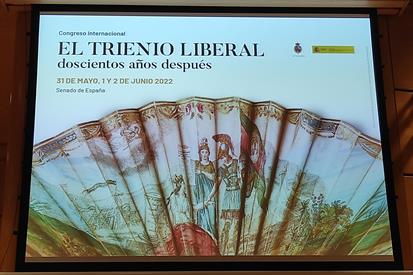
The Secretary of State for Democratic Memory, Fernando Martínez López, celebrated that the International Congress “The Liberal Triennium two hundred years later” has served to “know a history that has a lot to do with everything that is the background of Democracy and the Welfare State that we have, which somehow begins to emerge during this period”.
«These two and a half days of reflections and debates have allowed us from the Secretary of State for Democratic Memory to rescue the Liberal Triennium from oblivion and we have rescued it in an official way. The Government rescues a very important period for the memory of this country, because these days we have found the roots of the present, with a set of ideas and proposals of a time very rich in innovations and especially of formulas of political articulation collected over time by practically all political families,” said Martínez López moments before the closing of the Congress.
Fernando Martínez López added that the lessons learned from the International Congress on the abrupt end of the Triennium invite us to “reflect” on the dangers faced by democracies: “Today, more than ever, we must be alert to the new dangers, which are the new totalitarianism and neo-fascism that are beginning to be present in the institutions.”
Also the Professor of Constitutional Law of the University of Oviedo and co-director of the Congress, Ignacio Fernández Sarasola, has made a “very positive balance” of the meeting of specialists. “What has been provided is a multidisciplinary perspective that I believe was lacking until now, with teachers from very different fields, who have given their vision of very different aspects of the Liberal Triennium. He has cast a very multifaceted and very complete vision, filling all the pieces of a puzzle. There will always be things to do, but the vision can serve to set a guideline for the studies that can be addressed on the Triennium,” he concluded.
The International Congress “The Liberal Triennium two hundred years later” ended this afternoon after a day in which issues such as territorial organization have been addressed, analyzed by the professor of the University of León, Francisco Carantoña, who has highlighted the “decentralization and democratization” that occurred in that period. The Secretary of State for Territorial Policy, Alfredo González Gómez, moderator of the table, recalled that «one of the most important reforms» of the period was precisely that of the administration, «necessary to implement the liberal order against the structure of the Old Regime, fundamental for the structuring of the territory and its government».
The role of the press and freedom of expression has been the subject of another session, with a presentation by the professor of the University of Cádiz Beatriz Sánchez Hita and the guest speech by the journalist Montserrat Boix, from RNE, and the director of El Español, Pedro J. Ramírez, who celebrated the organization of the congress on a historical period that has positioned it as “an embryo of all the great themes that have structured the history of contemporary Spain”.
The fight for equality in the historical period, when there was no universal suffrage, has opened the evening sessions with a videoconference presentation by the professor of the University of Barcelona Elena Fernández, and interventions by the lawyer of the Cortes and ex-delegate of Government in Gender Violence, Blanca Hernández Oliver, and the professors Claudia Rosas Lauro (Pontificia Universidad Católica de Perú) and María Cruz Romeo (University of Valencia). The president of the Equality Commission of the Congress of Deputies and moderator of the table, Carmen Calvo, has stressed the relevance of devoting a specific section to women in the Triennium. “The representative state starts madly without us. Equality started without equality, we were on the fringes of freedoms,” she said of the situation of women.
The constitutional education of citizens has closed the issues addressed in the congress commemorating the bicentenary of the Liberal Triennium, promoted by the Ministry of the Presidency, Democratic Memory and Relations with the Courts, at a table moderated by the permanent ambassador of Spain to UNESCO, José Manuel Rodríguez Uribes, and composed by the rapporteur of the University of Valencia Pilar García Trobat and the guests Pilar Ballarín Domingo (University of Granada) and Olegario Negrín Fajardo (UNED).