
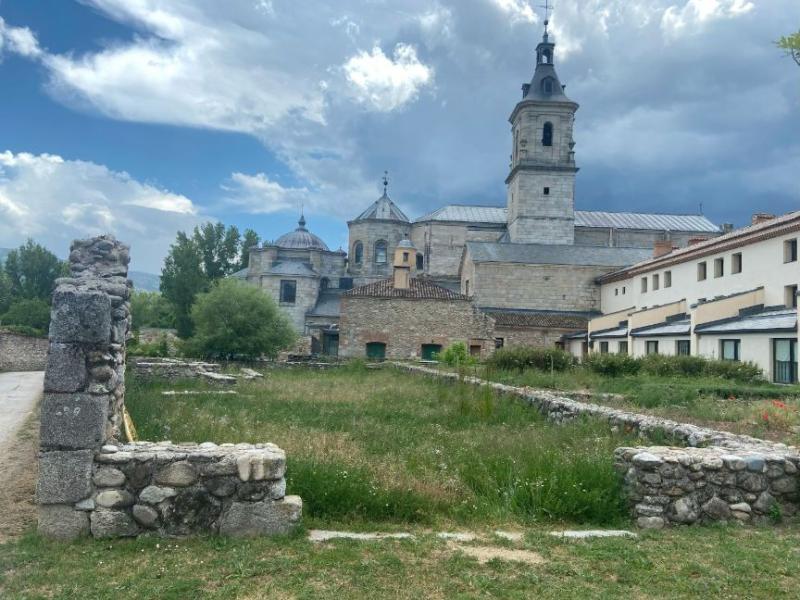
- The Ministry of Culture, through the Institute of Cultural Heritage of Spain (IPCE), carries out this intervention endowed with an investment of 3.7 million euros
- The intervention will solve the problems of watertightness and structural in different areas of the monastic complex, which have been aggravated with the torrential rains of recent weeks
The Council of Ministers approved on Tuesday, at the proposal of the Minister of Culture, Ernest Urtasun, the execution of emergency works in the Royal Monastery of El Paular in Rascafría (Madrid).
The action, with an investment of 3,763,295 euros, and with an expected execution time of 20 months, is intended to solve the problems of watertightness existing on the roofs of the main dependencies and the structural problems in the rooms located south of the Greater Cloister of the monastic complex, which have been aggravated by the torrential rains of recent weeks.
Among the different works that will be carried out, the problematic places will be identified and waterproofed to alleviate the humidity by infiltration on the covers. In addition, a subsequent restoration of damaged wall paintings, as well as deterioration in walls and vaults will be considered.
It will also be intervened to alleviate the humidity at the base of the walls, favoring the evaporation of water from the ground and avoiding the entry of water to the cardboard cells. Finally, the affected constructive elements in the southern panda will be consolidated, and the cells and the access gallery will be recovered.
About the Monastery of El PaularThe Royal Monastery of Santa María de El Paular was declared a Property of Cultural Interest (BIC) in 1876. It is attached to the Ministry of Culture and ceded the use of certain areas to the Benedictine Order, a community that has resided there since 1954.
The Cartuja de El Paular began its construction in 1390, at a time somewhat later than the first European Cartujas, in a land used by the kings of Trastcámara as a royal hunting ground and where there was a small hunting pavilion and a hermitage. During its first four and a half centuries of existence, El Paular became one of the most powerful carthusians on the European continent.
With the war of independence at the beginning of the 19th century and later the liberation of 1836, religious life was interrupted, to return a century later, in the middle of the 20th century, being the Benedictine monks, of the Sublacen Congregation, who inhabited part of the monastery since then.