
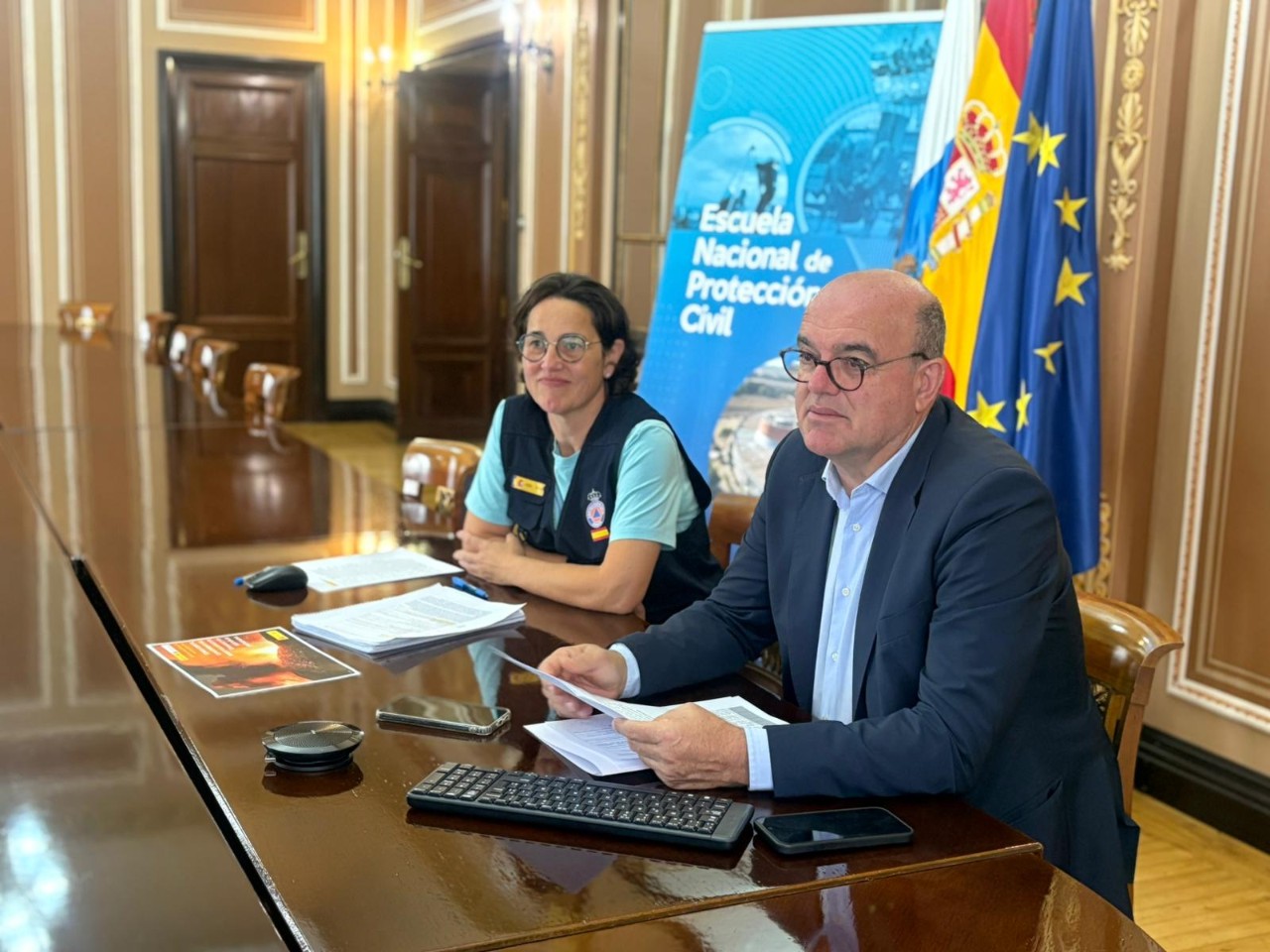
The government delegate in the Canary Islands, Anselmo Pestana, has inaugurated today the Course on the knowledge of volcanic risk in the Canary Islands and emergency managementorganized by the Civil Protection Unit of the Government Delegation within the framework of the activities of the National Civil Protection School of the Ministry of the Interior.
This training, which will be given in the form of a videoconference in six days until October 23, is intended for the services of intervention and assistance in civil protection emergencies of the Public Administrations that provide service in the Autonomous Community of the Canary Islands, as well as other agencies and services or public or private companies that are in some way related to volcanic risk.
The course seeks to offer a general knowledge of volcanic risk, explaining in a simple way all the elements of a volcanic process, and with the objective of training managers and technicians in the planning and management of emergencies derived from this type of risk, without forgetting the exposure of the consequences for the life and security of the population, its goods, animals and historical, artistic and cultural heritage, the return to normality and its subsequent recovery.
“Managing the consequences of volcanic risk and emergencies on people, their property, animals, the environment or heritage requires intervention and assistance professionals to have comprehensive knowledge at all stages. It is also essential to be clear about the situations that may arise, all in order to be able to anticipate management and decision-making, as well as the provision of means and resources that must be activated and the protection measures that must be adopted,” says Anselmo Pestana, who has welcomed the participants in the course from the headquarters of the Government Delegation, in Las Palmas de Gran Canaria.
“The lessons learned not only in La Palma in 2021, but also in El Hierro in 2011, have shown that it is necessary to ensure interoperability between the actors in the different action groups, as well as other elements of action and advice of the civil protection plans. Therefore, this training is necessary to comprehensively cover the concept of volcanic risk in all phases of the emergency cycle, from prevention to recovery”, he adds.
The course, in which the Special Commissioner for the Reconstruction of the island of La Palma, Héctor Izquierdo, will also speak, will address the volcanic history of the Canary Islands, the knowledge necessary to understand volcanic surveillance activity, as well as volcanic dangers, both direct and indirect, such as seismicity, land movements, tsunamis, afflictions to aquifers and ash collection.
An analysis will also be carried out of the management of the recent volcanic crises in the Atlantic archipelago, the volcano in Cumbre Vieja in La Palma and the submarine volcano in El Hierro, of the application of the Canary Islands Volcanic Emergency Plan (Pevolca), of the evacuation of animals, of the consequences on the health of the population that may bring a volcanic emergency, among them the derivation of the condition to air quality, and also of the management of public aid to alleviate the damages derived from the emergency.
In the presentations, the different administrative levels will be represented through the Delegation of the Government in the Canary Islands, the General Directorate of Emergencies and the Pollution Prevention and Control Service of the Canary Islands Government, the Island Council of La Palma, the National Geographic Institute (IGN), the Canary Islands Geological and Mining Institute (IGME-CSIC), the Institute of Natural Products and Agrobiology (IPNA-CSIC), the Spanish Oceanography Institute (IEO-CSIC), the Canary University
A representation of the Professional College of Psychology of Santa Cruz de Tenerife and the Red Cross will also take part in the training activity.
This training comes after that, at the initiative of the Island Council, the European exercise EU-MODEX Tenerife 2025 took place on the island of Tenerife from 22 to 27 September, with the participation of more than 1,000 security, emergency and rescue forces from different countries, an exercise that included the first simulation of volcanic eruption carried out in Spain.
The MODEX Tenerife 2025 is framed in the European Union Civil Protection Mechanism (UCPM), on which the Government Delegation in the Canary Islands, through its Civil Protection Unit, also organized a training day on September 10 to deepen the capabilities of the UCPM and its work in disaster risk prevention and management.