
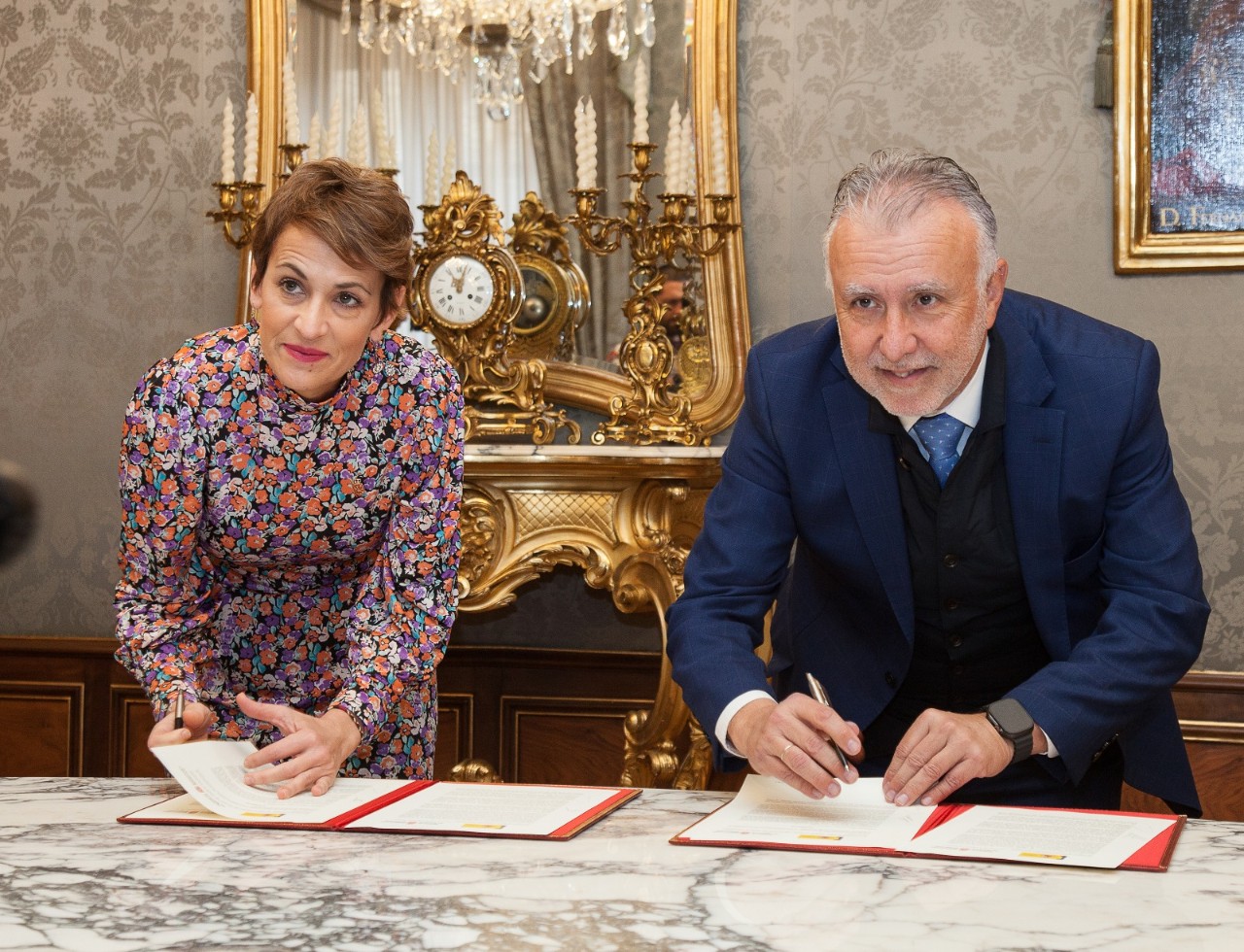
The Government of Spain and the Government of Navarre have today signed a Protocol of collaboration for the dissemination of the memory of the Fort of San Cristobal, which is a symbol of Franco’s repression and will be declared a Place of Democratic Memory. Ángel Víctor Torres, Minister of Territorial Policy and Democratic Memory, has signed this agreement, together with the president of the Foral Community, María Chivite. Then, the minister went to the Navarre Parliament to deliver declarations of Recognition and Reparation to the families of 32 men and women of this region, who were victims of the War and the dictatorship.
The Fort of San Cristobal was used as a criminal after the coup d’état. Thousands of people were imprisoned, without judicial procedure. “What was conceived as a military fortress became a prison of shame, where cold, overcrowding, hunger and diseases such as tuberculosis were respected,” the minister said.
This site experienced one of the most important collective leaks in contemporary Europe. About 800 inmates escaped, on May 22, 1938. “Some of them even said: ‘I prefer to be shot in the bush at this slow death’; which gives us the height of hell they were made to suffer,” added Torres. Only three of the escapees managed to cross the border into France, they were killed by dozens and many others were re-imprisoned.
The minister has pointed out that on July 2, the file was opened to declare this symbolic site as a Place of Damocratic Memory and its definitive statement will be published in the BOE soon. “We owe it to those brave men and to all the people who were imprisoned and silenced,” he added.
Recognition of workers
After the signing, the minister delivered personal statements of Recognition and Reparation to the families of 32 men and women of Navarre, who were victims of the Franco repression. “The people we pay tribute to today were, above all, workers. They built the land, shaped the wood, the stone and the metal; they were public employees, shopkeepers; workers, workers, militants or not in political parties and unions,” said Torres, who asked: “What right did anyone have to stop their way?”
Torres has indicated that “today democratic principles and human rights are being compromised in many parts of the world,” and has stressed that the best “antidote” against that setback is “memory.” And he has appealed to explain to the “what it has cost to build the freedom they enjoy.”
The act of recognition, in addition to the minister, was attended by, among others, the president of Navarre, María Chivite, the president of the Parliament of Navarre, Unai Hualde, the Secretary of State for Democratic Memory, Fernando Martínez, the delegate of the Government in Navarre, Alicia Echeverría, and the president of the Association of Relatives of Fusilados de Navarre (AFFNA-36), Amaia Lerga.