
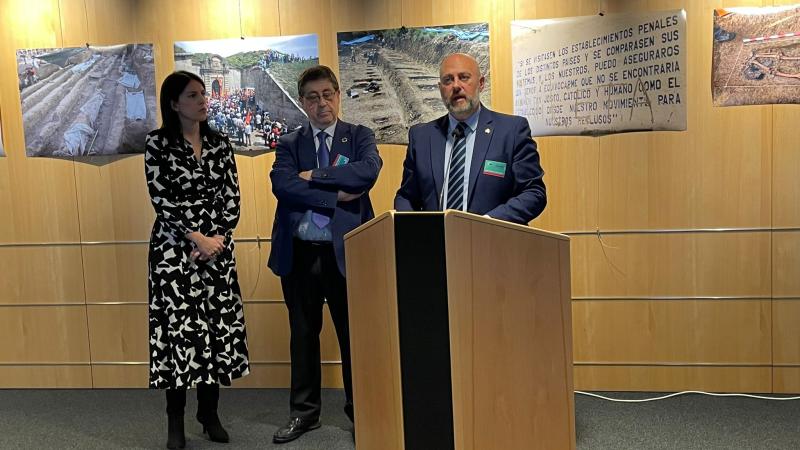
The government delegate in Navarre spoke today at the opening of an exhibition of the Association of Relatives of Executed Persons of Navarre in the European Parliament. José Luis Arasti has pointed out the importance of bringing to the community institutions the voice and the graphic testimony of the work of AFFNA 36 and its struggle to dignify the victims of Franco’s regime.
“Unearthing the silence” is a photographic exhibition that collects the work of the Association and some of the actions carried out in Navarre, such as tributes or exhumations, within its defense of truth, justice and reparation.
The government delegate has stressed the central executive’s “sensitivity” and “commitment” to these issues. And he recalled that in October the Senate definitively approved the Democratic Memory Act. It is a norm that is based on the principles of truth, justice, reparation and guarantee of non-repetition, that expressly claims the Transition and the defense of democratic values, and that condemns for the first time the military coup of July of the 36th and the Franco dictatorship.
“With this law, we are turning the page of the darkest stage of our recent past, of dictatorship and civil war, and embracing and vindicating the best of our history: the people who fought for democracy, for the Transition, for the Amnesty Law and for the Constitution,” said Arasti.
It has also pointed out that, as a result of this law, the State assumes leadership in the search for and identification of missing persons and in the promotion of exhumations. On the other hand, the illegality of the Franco courts of exception and the nullity of sentences are declared, placing the victims at the center of public action. And it is firmly committed to education and research in the field of democratic memory.
“Today Spain is a fairer country thanks to the Democratic Memory Law; because it offers dignity to victims and their families, takes them out of ostracism and guarantees truth, justice and reparation,” added the government delegate in Navarre.