
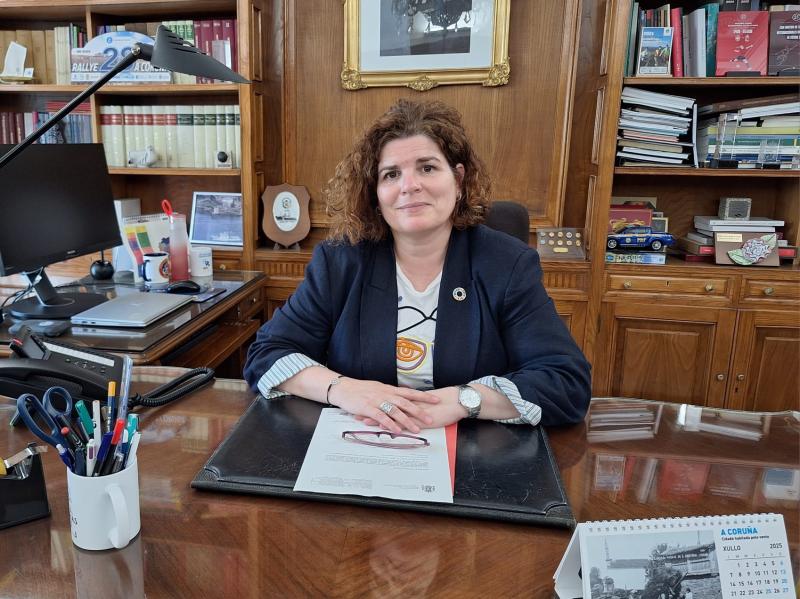
The deputy delegate of the Government in A Coruña, María Rivas, reviewed this morning the advances and improvements that the Government of Pedro Sánchez promoted in this first half of the year in the province of A Coruña. It did so through the data provided in the Spanish Government’s biannual accountability analysis, the Complying report, presented last week by the President of the Government. “A report that puts figures, projects and concrete faces to a committed, close and transformative government action for the citizens,” he said, ratifying with figures the deep and sustained commitment of the Government to the Coruña, highlighting the many opportunities to continue transforming its economy and consolidating job creation with the Recovery Plan, which proved to be “an essential tool of the Government to improve the province and boost it for the future.”
In Galicia there are already more than 60,000 beneficiaries of the Recovery, Transformation and Resilience Plan (PRTR), raising its investment in the territory to 4,124 M€. In addition, he stressed the Government’s deep support for the Galician productive fabric, since 42% of those beneficiaries of the PRTR are small and medium-sized enterprises “which reflects an equitable and close distribution of public resources,” he said.
Among the remaining beneficiaries are practically all the other possible entities, from larger companies to foundations or municipalities “facilitating a balanced and diversified distribution of these funds”.
Dynamisation and economic boost
The subdelegate reported that, under the Recovery Plan, the Government’s strategic projects for recovery and economic transformation (PERTE) left in Galicia more than 811 million euros in aid to companies in the community.
Tourism and trade play a key role in this commitment to sustainability and digitalization. In Galicia, one in two municipalities is already benefiting from the more than 200 million euros of the Government for the transformation and modernization of the tourism sector, while in the field of trade projects were promoted to make urban and rural markets more sustainable and strengthen commercial activity in tourist areas, with a contribution of 23.29 million euros.
The subdelegate also stressed the Government’s support for strategic sectors such as the naval sector that resurface with contracts such as the frigates of the F-110 series for the Spanish Navy, with more than 4.3 billion euros for Navantia, to which must be added the 440 million committed for the construction of a Supply Ship in Combat (BAC) also in the public shipyard, which receives 170 million euros within its digital transformation plan for the construction of the block workshop. This adds up to a total investment for Ferrol of more than 5 billion euros. “These are figures that consolidate the industry, reactivate employment and project the Ferrol region into the future,” he said.
Another of the key axes of action is the transition towards a more efficient, social and sustainable model. In this area, the Government allocates more than 300 million in Galicia to the development of green energy projects to reindustrialize the Community, supporting green hydrogen initiatives, thermal production with solar or xeothermal energy, or the use of offshore wind or wind energy, among others. €181m of these correspond to the PERTE of Renewable Energies, Renewable Hydrogen and Storage (EHRA) and €30 to the RENMARINAS program, in Arteixo, through the PRTR. The Autonomous Community received 17.5 M€ in this field, of which 38% was executed. In addition, it received €106.9 million to boost self-consumption and residential storage, of which it executed 65%.
In the PERTE ERHA, the As Somozas wind farm stands out, which receives 13.4 million.
In the PERTE of Circular Economy stand out the €4.4 million for efficient installation giving use to the raw material of proximidade with a low carbon footprint in Boiro, or the PERTE CAMPO with €0.3 million for the wholesale trade of fish and seafood and other food products to the company Kibus Food Distribution, in Oleiros. The H2POLE project in As Pontes, with 15 million euros, will allow the start-up of a 100-megawatt hydrogen plant. It plans to create 100 direct and indirect jobs in its exploitation phase. The GP H2 project in As Pontes, with another 15 million euros, will allow the lifting of a PEM electrolyser destined for industrial use for self-consumption, ammonia production and fertilizers. It plans to create 60 direct jobs.
Within the incentive program 3 renewable H2 value chain, Naturgy New Energies SLU receives €15M to install a renewable hydrogen production plant in Meirama, which will allow it to obtain 4,500 tons of hydrogen per year.
In the PERTE of microelectronics and semiconductors (CHIP), the company Maxwell Applied Technologies in A Coruña received 1.4 million euros for the design and development of innovative solutions for state-of-the-art communication systems.
Within the PERTE Social Economy, in the line of action of Bioeconomy, 1.3 million euros were allocated for the project of "Ecosocial Laboratory of Barbanza". Likewise, the Technological Center of Supercomputing of Galicia (CESGA), in Santiago, receives 47.7 million euros to improve its facilities.
In the area of Tourism, 2.5 million euros were allocated for two projects of Tourist Experiences of the Galician Association of Nautical Activities and the Region of Ferrol, and 11M€ for the Parador de Santiago de Compostela.
Protection of the welfare state
In addition to promoting the transformation of the production model, other axes of action of the Government is to respond to the needs of the population because “we are not only talking about large projects. We also talk about people,” said Rivas.
In this regard, the subdelegate recalled that the Executive of Pedro Sánchez committed 526 million euros to promote housing policies in Galicia, an investment that will allow the construction of 1,406 public homes and the rehabilitation of more than 18,000 homes in the community. Thus, a total of 92 million has been transferred to the Galician Administration to build and rehabilitate just under 4,000 homes. The novelties in respect of housing are important, since A Coruña has just been declared the first ‘stressed area’ of Galicia, which will benefit the lowering of rental prices by limiting housing for tourist use, bumping rents and boosting tax benefits and aid, since this city can avail itself of the Housing Law developed by the Government, “which abounds in guaranteeing that in Spain housing is a right and not a market good”. It is not the only Galician city that pursues this goal, since Santiago de Compostela also aspires to achieve this status.
Thanks to the Government’s commitment to link the increase in pensions to the IPC, the more than 310,000 retirement pensions of the population of the province of Cordoba increase more in one year than in all the years together of the PP executives. Thus, the average monthly income of a retired Corunnese person is 399 euros higher today than at the same time of 2018, currently reaching 1,358 euros compared to 959 at that time.
And just as pensions grew, so did wages. Thus, the subdelegate pointed out that since the government of Pedro Sánchez, the minimum wage rose almost 400€, more than 54%, respecting the 736 euros left by the PP. Now, the 135,900 Galician workers who receive the legal minimum charge 1.134 euros per month. In A Coruña there are more than 35,000 beneficiaries of the Minimum Vital Income, which, like pensions, was revalued this year by 2.8%. In addition, the Social Electric Bonus has 38,171 beneficiaries.
The province reaches 484,098 members of the Social Security, with a monthly and year-on-year growth of 0.77%, with an increase of 51,674 people employed more than in June 2018. In addition, 98,917 indefinite contracts were made, which is 142% more than in 2019.
In the field of education, the subdelegate highlighted the increase in the stock exchanges and their amount in Galicia, with 132 million euros (an increase of 59% in eight years of government) the stock exchanges to help 54,000 young people with their studies. In FP, 42,426 places were created, of which 63% correspond to training cycles related to digitalization. In A Coruña, the places related to training cycles of digitalization are 11,928. In addition, since January 1, 2024, students who perform unpaid training practices are included in the Social Security system. This measure allowed that, from its entry into force until June 30, 2025, almost 30,000 students from the province were discharged from Social Security for taking unpaid internships. The contribution entails generating rights to future benefits, such as retirement, and expanding the social protection of these students.
In addition, more than 10,000 young people and girls from the province who reach the age of 18 in 2025 will be able to benefit from the Young Cultural Voucher with 400 euros to access cultural products by just registering on the portal www.bonoculturajoven.gob.es before October 31.
On the other hand, Rivas referred to the commitment of the Government in the fight against gender violence, with more than 783,000 euros for the municipalities of the province to fight against male violence from the funds of the State Pact against Gender Violence for the year 2025.
Infrastructure and green and digital transition
The provision and improvement of infrastructures is another of the axes that mark the action of the Government in Galicia, while continuing to advance in the commitment to the railway. The Avril trains were put into service, which since connecting Vigo and A Coruña with the Plateau add more than 1.5 million users. The intermodal of Santiago de Compostela was completed this June, and we must not forget the railway accesses to the external ports of Ferrol and A Coruña, which add up to another 200 million. It allocates an investment of 71 million euros for the execution of the works of the remodeling of the A Coruña–San Cristobal station and signage, train protection systems, centralized traffic control and communications of the A Coruña station.
In the field of roads, after a prolific 2024 that brought with it an investment of 650 million euros in improvements such as the first stretch of the La-57 in Pontevedra; the Orbital, in Santiago; the link of ‘Sol y Mar’, in the metropolitan area of A Coruña, or the opening in record time of the viaducts of the Castro in the A-6, continues to advance in 2025.
Currently the Government is executing in Galicia 50 km of new roads that represent an investment of 387 million euros, including the remodeling of Alfonso Molina in A Coruña or humanizations such as those of Milladoiro (Ames) or the one completed last week in Las Pías (Ferrol).
In terms of sustainable and digital mobility, €20M was allocated for Coruña; €3.9M for Santiago; €1.6M for Arteixo; €1.5M for Narón and one million for Ribeira.
In the section on the rehabilitation of public buildings, the municipal PIREP highlights the rehabilitation of those bought from Monte Alto and Santa Lucía in A Coruña, with 5.9 million euros, or, in the autonomous PIREP, the rehabilitation of the administrative building of the Ministry of Environment in A Coruña, with 2.3 M€.
In the section of renaturalization of the cities, the 3.6 million euros received by Santiago de Compostela for the project “Entre Sar e Sarela”, to boost the green infrastructure of the city to favor the ecological connectivity of the Outer Green Ring with the urban plot.
Other noteworthy performances are the conditioning of a pedestrian path between Cabo Vilán and the Cemetery of the English in Camariñas, with two million euros.
Galicia will receive in 2026, in addition to the funds of the Recovery, Transformation and Resilience Plan (PRTR), the largest installments in its history for the second consecutive year, amounting to 10,878 million euros and representing 6.2% more than in 2025, when the milestone of 10,239 million euros in installments on account had already been achieved. This is in addition to the settlement of 2024, which puts the total amount that Galicia will receive next year at 11,582 million euros.
“All this shows that we have a government that invests, that transforms, that protects and that guarantees rights. That leaves no one behind, and that works for a sustainable, modern and fair future for the province of A Coruña”, concluded the subdelegate.