
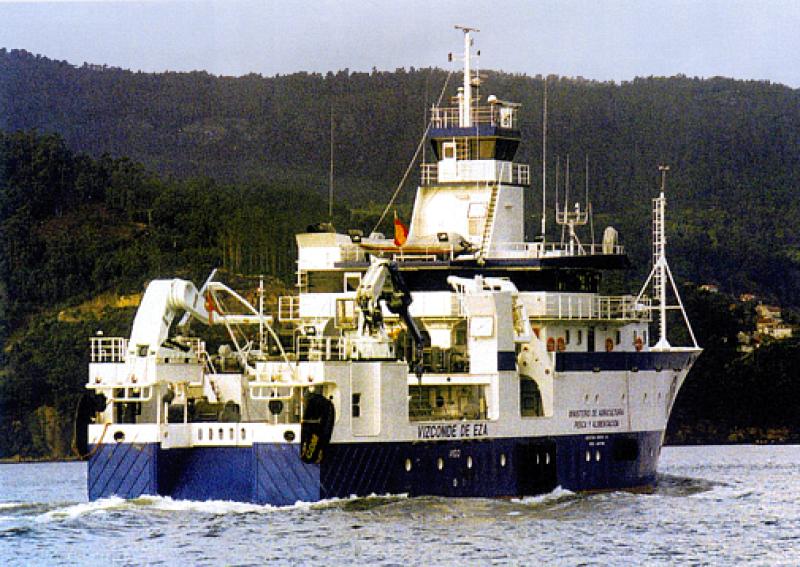
The Ministry of Agriculture, Fisheries and Food and the Spanish Institute of Oceanography (IEO) have launched the Jureva 2025 oceanographic campaign, which will last until April 24, in the Bay of Biscay and the Bay of Biscay. The objective of the campaign, which is carried out on board the ship Vizconde de Eza, is the estimation of the mackerel spawning biomass from the method of egg production.
This technique calculates the abundance of breeders from the number of eggs collected with plankton nets and analyzes the presence of other commercial species that spawn in spring, such as sardine and anchovy. A campaign that is complementary to the one carried out in the month of March (Careva) and is also coordinated with the Pelacus campaign, which will begin in early April. All of them are dedicated to the study of pelagic species.
Due to the migratory nature of the mackerel during its prolonged reproductive period and its distribution from northern Europe to Portugal, the data of the Careva campaign will be combined with those of another 16 campaigns. The objective is to collect data from seven countries between January and July within the framework of the working groups of the International Council for the Exploration of the Sea (ICES).
In these working groups, the corresponding reports are prepared on the status of the populations of the different species and their future perspectives and scenarios. These are species that are captured, mainly, by the fleet of the censuses of siege, enamel, drag and minor arts of the Northwest Cantabrian. The data of this campaign are a fundamental pillar for the evaluation of these stocks and the adoption of appropriate and proportionate management measures, as well as the allocation of Total Allowable Catches (TACs), and quotas.
This campaign responds to different commitments made by the Ministry of Agriculture, Fisheries and Food at international level for the sustainable management of the seas and is part of the national program of basic data of the fisheries sector cofinanced with the European Maritime, Fisheries and Aquaculture Fund (FEMPA).
The Ministry of Agriculture, Fisheries and Food provides the vessel Vizconde de Eza and the crew that facilitates the use and equipment of researchers, while the scientific direction of the campaign is held by the Spanish Institute of Oceanography. This campaign is another example of coordination between the ministry and the IEO in order to achieve an optimization of resources for the benefit of the best possible scientific knowledge and fisheries management.