
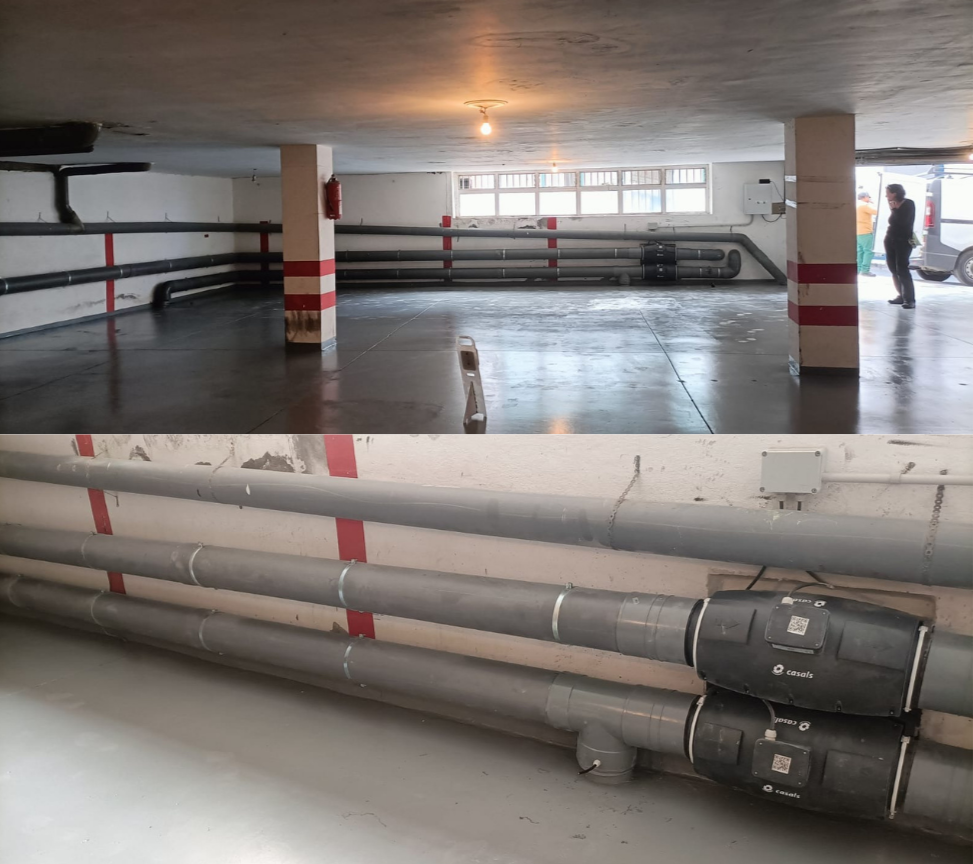
The proposed technique results from an adaptation of the methods used to extract radon gas by the Eduardo Torroja Institute of Construction Sciences (CSIC - Ministry of Science, Innovation and Universities), in collaboration with the National Geographic Institute (IGN - Ministry of Transport and Sustainable Mobility) and CIUDEN (Ministry for Ecological Transition).
The Special Commissioner for the Reconstruction of La Palma, Héctor Izquierdo, stressed the role of the project within the process of progressive recovery of coastal areas, highlighting the commitment that has always been maintained by the scientific personnel who have been working on the island since the eruption began. “In Puerto Naos there are already few homes to meet the safety parameters for their authorization and the situation of the latter is more complex, so this type of advanced solutions, developed together with the scientific institutes, allow us to face the mitigation phase with technical rigor and confidence.”
First-level science in palmer terrain
The initial tests are being carried out in a garage in the ‘black zone’ of Puerto Naos, which records high concentrations of CO₂, where carpet has been installed. This system allows to generate a pressure gradient that prevents the entry of gases to the living spaces. The experiment is articulated in three phases: the initial phase, in which it is currently, of compression and suction of the gas in the subsoil; a second step that seeks the channeling of the flow towards controlled release points and, finally, the capture and storage or dispersion in safe areas.
The mitigation program is part of the effort promoted by the Commissioner for the Reconstruction of La Palma to turn the island of La Palma into a scientific laboratory of international reference, in which advanced technologies of monitoring and control of gases are developed, such as the network CO₂ Alert, operative 24/7 and with more than a thousand sensors installed.
These actions, together with the implementation of the National Plan for Seismic, Volcanological and Other Geophysical Monitoring, promote safety, innovation and resilience in volcanic environments, opening the way to a safe and sustainable coexistence with the geological environment. “The eruption placed La Palma at the centre of the global scientific scene. This type of initiative shows that applied research can restore habitability and confidence to the affected areas,” concluded Héctor Izquierdo.