
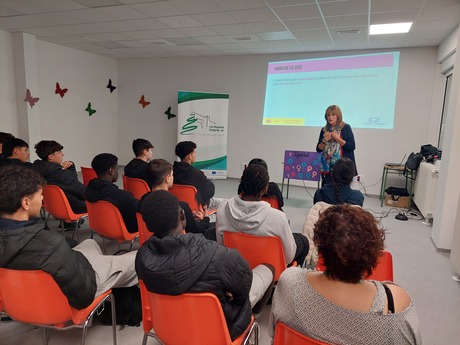
The Government delegate in Navarre, Alicia Echeverría, has visited one of the sessions of the Master Plan for Coexistence and Improvement of School Safety in Navarre that begins with the start of the new course. This is the workshop “Hate in Networks”, an action on misogynistic messages and toxic masculinity in social networks given by the head of the Coordination Unit against Violence on Women, Estrella Lamadrid, at CIP Huarte. Both have been accompanied by the director of the High Inspection of Education in Navarre, María Yolanda Salinas, and by the director of the center, Esther Fernández.
Echeverría has highlighted the high participation in the Master Plan that, during the past year, reached more than 76,000 schoolchildren throughout Navarre, 12 percent more than in the previous year. “This data shows the growing interest in the activities offered and, of course, the commitment and trust that schools have placed in this program,” said the Government delegate.
In this new edition of the Master Plan for Coexistence and Improvement of School Safety in Navarre, several lines of action are proposed: school harassment, youth gangs, gender violence, use of the internet and new technologies, filio-parental violence and abuse in the family environment towards childhood and adolescence, trafficking and exploitation of human beings, prevention of sexual crimes, speech and hate crime, road safety, and drugs and alcohol.
The Plan, coordinated by the Directorate of the High Inspection of Education in Navarre, is aimed at schoolchildren, teachers and APYMAS, and includes actions of the Ministry of the Interior, the Department of Education, the National Police, the Foral Police, the Municipal Police of Pamplona, the Civil Guard, the Institute of Public and Labour Health and the Unit for Coordination against Violence against Women.
Since the High Inspection of Education, this plan has been sent to all schools in the Foral Community, accompanied by a letter from the Government delegate inviting them to participate in the actions offered, including school competitions, talks for teachers and students and training activities. The Plan is also available on the web pages of the Government Delegation and the Department of Education.
The objectives include bringing public security services closer to the educational community, providing technical assistance to prevent and address conflicts of coexistence, and helping to improve all types of security problems that affect young people.
About the Master Plan
The Master Plan for the Coexistence and Improvement of School Safety originated in 2006, when the Ministries of Interior and Education and Science signed the 'Framework Agreement on Education for the Improvement of Safety'.
Last year, the training actions were carried out mainly in the format of talks and conferences, in addition to including the program “Education, Lifestyles and Healthy Environments”, implemented in 33 schools, and participation in the “Network of Health Promoting Schools”.
Among the most outstanding actions, they highlighted the prevention of ludopathies, road education, risk prevention on the internet, addiction to screens and violence in the digital environment.
Afftive-sexual education was also widely demanded by the centers, with the aim of promoting the construction of healthy relationships and identifying micromachisms. Among these activities, the most requested workshops were “That is not love”, aimed at schoolchildren, and “Your children see porn”, aimed at APYMAS, which addresses the effects of early exposure to online pornography.
A total of 28,311 guides and brochures on addiction prevention were published and distributed. Of this total, 1,861 materials focused on alcohol prevention, 5,822 on tobacco use prevention, 2,246 addressed drug prevention, 1,590 focused on play and screen use, and 405 addressed sexual health issues.