
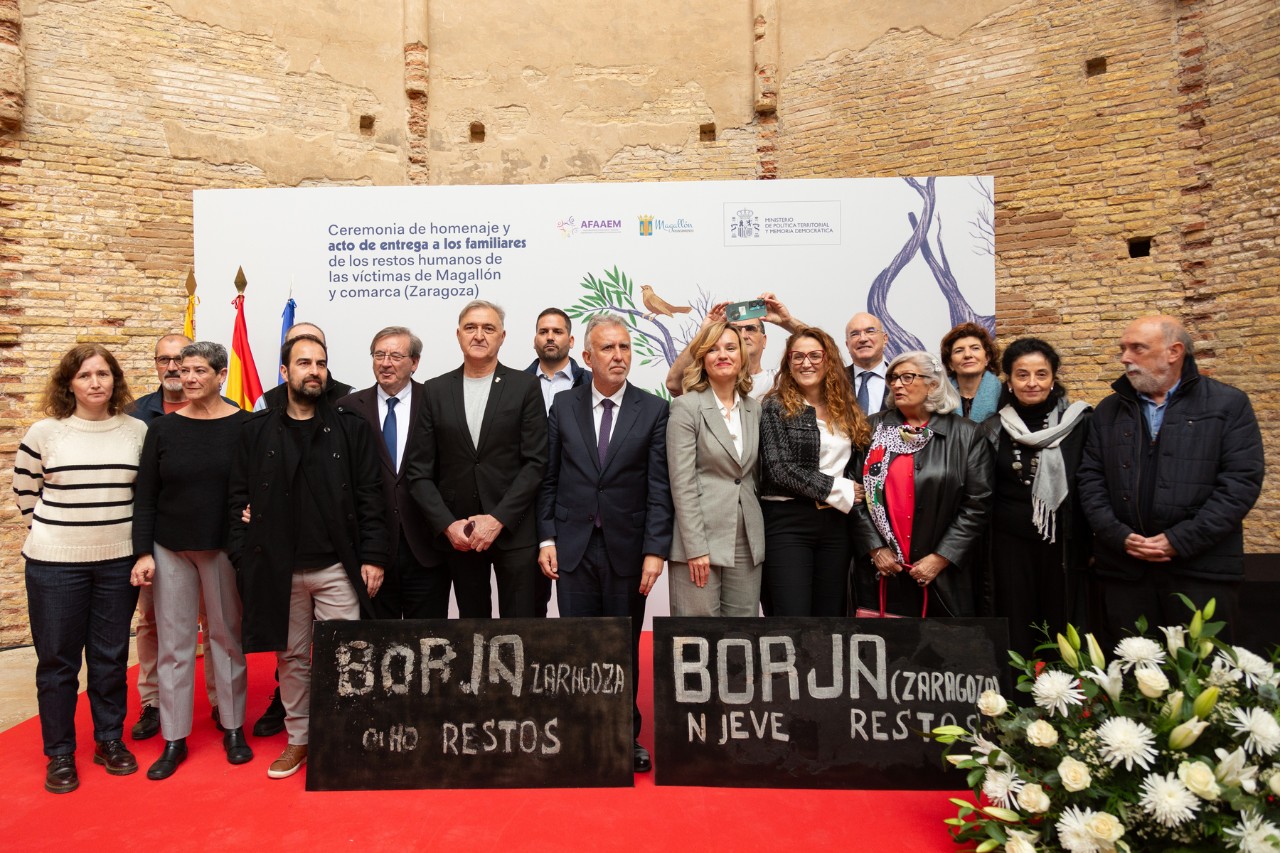
The Minister of Territorial Policy and Democratic Memory, Ángel Víctor Torres, and the Minister of Education, Vocational Training and Sports, Pilar Alegría, delivered today, in Magallón (Zaragoza), the remains of 17 victims of the War, found in the Cuelgamuros Valley. Of these, four people have been identified: Esteban Jiménez, Juan Chueca, Felipe Gil and Pedro Peralta; whose families have today been able to recover their remains.
“The vocation of the Government of Spain is to locate every last body and deliver the remains to as many family members as possible,” said Torres. “Our commitment is to comply with the victims and their families; with the Democratic Memory Act and with international law. We know that this is the best way to defend our democracy”, added the minister, during the tribute ceremony held in the Ramón Salvador de Magallón auditorium, which was also attended by the Secretary of State for Democratic Memory, Fernando Mártínez.
Minister Alegría, who gave the forensic technical reports to the families, said that “it is a day of justice and reparation, of commitment to democracy and dignity. Today we want to honor Stephen, John, Philip and Peter, because they are finally coming home.” The minister wanted to thank the forensic teams and also the memory associations for their work, in this case the Platform of Action for the Memory of Aragon, and added that “light, transparency, justice and truth can never be a problem. We cannot erase the story, we cannot erase the memory, we cannot allow the ultras to impose their discourse. To do so is to be complicit in them.”
Article 22 of the Democratic Memory Act provides for the restitution of exhumed remains to their relatives. In this way, the Government of Spain has today proceeded to the dignified delivery of the remains of these four people who, after their murder, were buried in a common grave in the cemetery of the town of Borja (Zaragoza). Later, their bodies were exhumed, without the knowledge of their relatives, and transferred to the Cuelgamuros Valley. In total, 17 bodies were transferred in two collective boxes, registered with numbers 2,034 and 2,035, on April 8, 1959, from the town of Borja.
The investigation carried out by the technical forensic team has made it possible to locate these two boxes and all the remains, and the forensic exhumation, anthropological and genetic analyses carried out have allowed the identification of the four victims honored today.
“So far, we have been able to exhume 5,600 bodies throughout the country, and we are working hard to identify the victims, in a process that is complex and conscientious,” explained Minister Torres, who has revealed that 15 people have already been buried in Cuelgamuros to which it has been possible to put “name and surname”.
Torres has also said that he hopes that events like today’s will “help the current generations to know who the honored people were; their stories, why they fought, how their lives were and how they were uprooted by defending democratic legality”, since, the minister continued, “the whole of society is indebted to them. Their sacrifice and that of those who followed them have built the mature and advanced country that we now enjoy.”
In this context, Ángel Víctor Torres has emphasized, the Government of Spain has promoted the commemoration of the ‘50 years of Freedom’. “To celebrate democracy and not allow anyone to take it away from us or try to rewrite our history,” he said.
Plaque in Borja honoring the victims
The Minister of Territorial Policy and Democratic Memory; and the Minister of Education, Vocational Training and Sports have also participated in an act of tribute to the victims in the town of Borja, where the bodies were killed and buried in August 1936, without knowledge of their families.
The ministers have unveiled a plaque in memory of the 17 victims in the cemetery in the town of Zaragoza.