
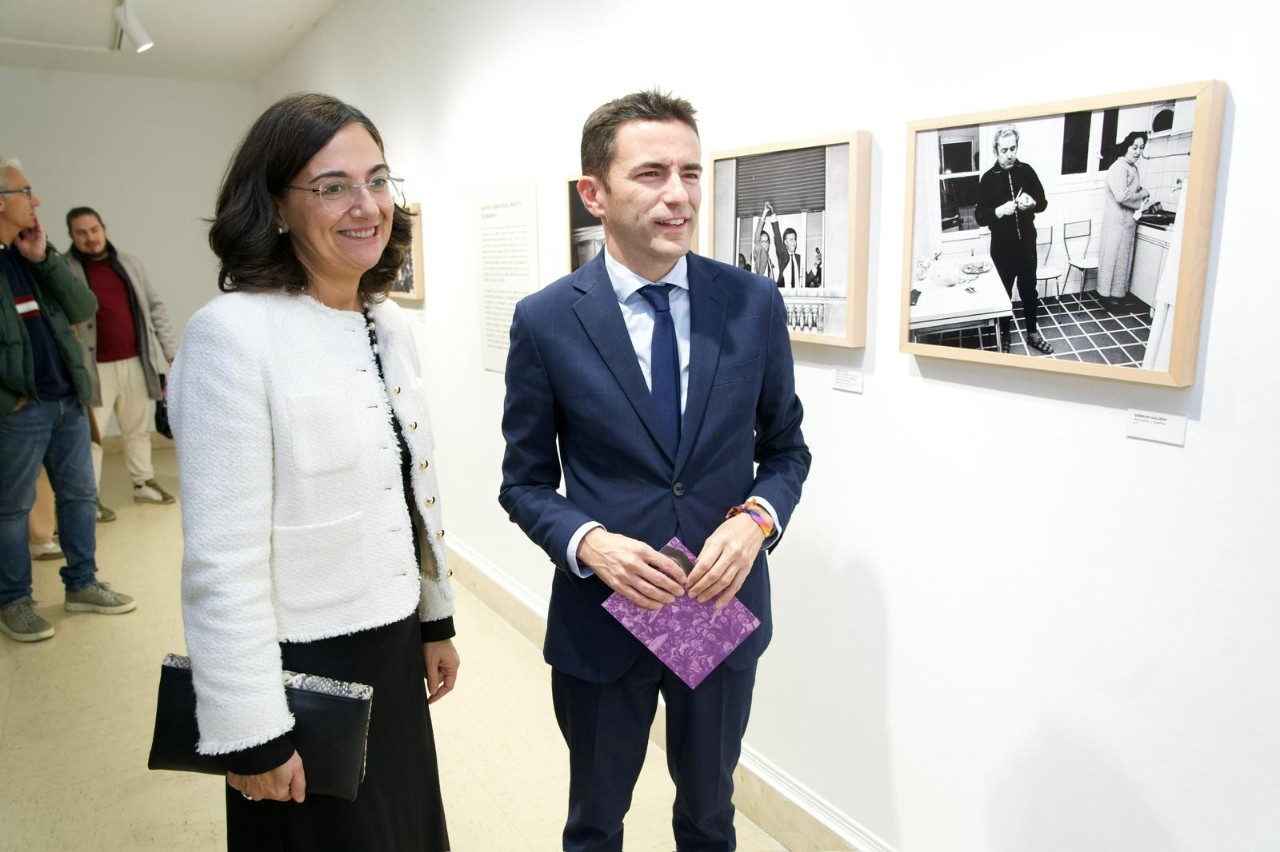
- The government delegate in Cantabria and the rector of the University of Cantabria have inaugurated this exhibition, which can be seen until January 16 in the University Room of the Superior Technical School of Nautics
The Government Delegation in Cantabria, in collaboration with the University of Cantabria, brings to Santander the exhibition ‘The Revealed History. Photojournalism and Spanish Transition (1975-1982)’ to “recover those images that marked the transition from dictatorship to democracy and highlight the most exciting stage of Spanish politics”.
The government delegate, Pedro Casares, and the rector of the UC, Conchi López, inaugurated this Wednesday the exhibition that is part of the activities of ‘Spain in Freedom. 50 years’ of the Government of Spain.
The exhibition is entitled ‘The Revealed Story. Photojournalism and Spanish Transition (1975-1982)’ and, with it, Casares has extolled that the Government Delegation “wants to recover those images that marked the transition from dictatorship to democracy”.
“We will be able to enjoy photographs that mark an era, that are a visual witness of a historical moment and that reflect the best stage of our collective history as a country,” said Casares, who stressed that the Transition as a “historical period” for the “work of many”, the “collective effort” and “the shared illusion of a country” to “recover its rights and freedoms.”
On the occasion of this exhibition, the government delegate has also called for “reflection” on “everything achieved” in the 50 years of democracy and to defend
“that the only dictatorship worth it is that of respect, respect for the rights and freedoms of all, equal opportunities and social justice.”
“Let’s not allow tension, hatred and division to continue to grow,” said Casares, while urging that the 50 years of democracy achieved “will only be the beginning of more progress and well-being and not the beginning of setbacks.”
For her part, the rector Conchi López stressed that “this exhibition not only invites us to look at the past, but to reflect on the value of freedom, coexistence and the role of knowledge in democratic construction”.
He also highlighted “the importance of hosting at the University of Cantabria an exhibition that combines history, art and collective memory, and that also constitutes a lesson in citizenship for the new generations”.
IMAGES OF AROUND THIRTY PHOTOJOURNALISTS
This exhibition is the second time that this exhibition has been exhibited in Spain, since during 2024 it could be seen in the Espai Anillo of the Miguel Hernández University of Elche, and is the result of ‘FOTOTRANS. Project on photojournalism during the Transition (1975-1982)’, an R+D+I project that was funded by the Ministry of Science and Innovation and the State Research Agency.
In it, you can see images that about thirty photojournalists collected with their cameras and with which they showed “unique testimonies of a fundamental time in the history of Spain such as the Transition”.
The authors who signed the images collected in this exhibition of the FOTOTRANS project are Guillermo and Manel Armengol, Pilar Aymerich, Carlos Bosch, Demetrio E. Brisset, Raúl Cancio, Enrique Cano, Xosé Castro, Colita, Gustavo Cuevas, Paco Elvira, Pepe Encinas, Marisa Flórez, Antonio Gabriel, Germán Gallego, Manuel Hernández de León, Pablo Juliá, César Lucas, Ricardo Martín, Andrés Palomino, Bernardo Pérez, Manuel Pérez Barriopedro, Benito Román, Juan Santiso, Francesc Simó, Jordi Socturías, Subau.
The exhibition structures the transition period into seven themes: 'Agitation in the streets'; 'Return and reconciliation'; 'New leaderships, new scenarios'; 'Violence and terrorism'; 'Cultures and countercultures'; 'For freedom' and 'Living every day' and, after its inauguration, two of the 10 researchers participating in the project, Lorna Arroyo of the UC and Leonardo Spinelly of the University of Alicante, have offered a guided tour.
The exhibition can be visited in the University Room of the Superior Technical School of Nautics of the University of Cantabria, until January 16, from Monday to Friday from 17.00 to 20.00 hours, except holidays.