
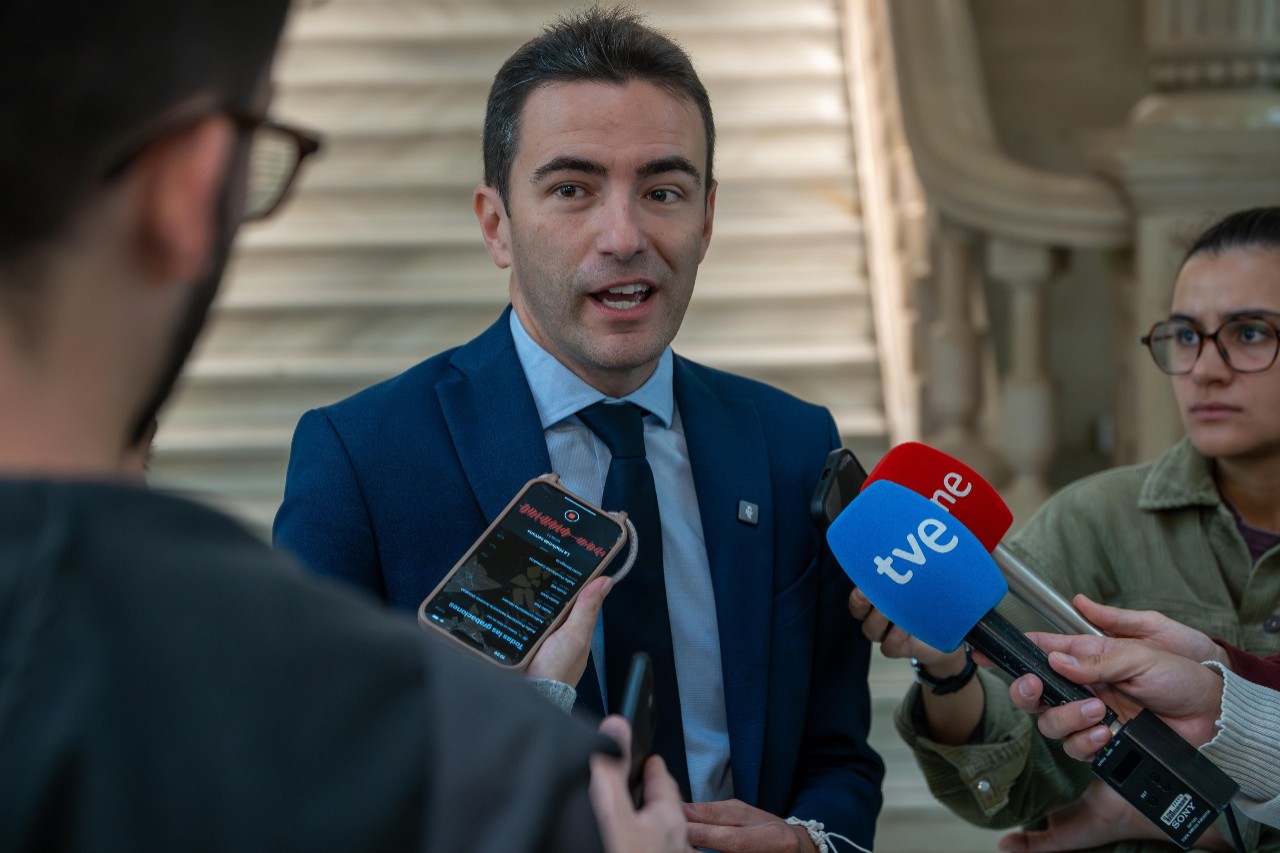
- The government delegate in Cantabria visited this Thursday the Delegation of Finance and headquarters of the State Agency of Tax Administration (AEAT)
The government delegate in Cantabria, Pedro Casares, has claimed that the Government of Spain does “State policy” with the self-employed and not a “jumble” of proposals as launched by the PP, “many that also already exist” and with which there is evidence of a “wide ignorance” on the part of the main opposition party.
Casares pointed this out this Thursday before visiting the Treasury Delegation in Cantabria and headquarters of the State Tax Administration Agency (AEAT), where he recalled that currently the self-employed can already make work on their own and on behalf of others compatible, “it is called pluriactivity and is recognized in our legislation” and currently there are around 270,000 self-employed in that situation.
He has also indicated that the self-employed can continue working after retirement, a measure called “active retirement”, which allows the retirement pension to be compatible with self-employment up to 100%, and which was agreed within the framework of the social dialogue.
Likewise, Casares referred to the PP’s defense of the importance of self-employed workers in cities and regretted that he made this proposal during his visit to the Cantabrian capital, in Santander, where “the replacement of traditional trade by franchises is a constant.”
Regarding the zero quota for the self-employed, the government delegate pointed out that there is already a “flat rate for the self-employed for two years” and, in addition, it is a proposal that in practice already exists “thanks to the measures of the Government of Spain and the Autonomous Communities”.
“The measures of the Government of Spain and the measures of the communities translate into a zero quota for many self-employed people, who no longer pay a quota in this country,” he said.
“THE GOVERNMENT DOES NOT WANT TO DEPROTECT THE SELF-EMPLOYED”
In his opinion, “when the PP says that quotas must be abolished, what it says is to deprotect the self-employed”. “These are all measures to ensure that the self-employed do not gossip and do not pay, and that translates into deprotection and the Government of Spain wants to protect the self-employed,” he said.
In this regard, he recalled that the Government improved the retirement benefit for the self-employed in 2022 and is currently working on another “ambitious” improvement of these benefits.
Likewise, taking advantage of his visit to the headquarters of the AEAT, Casares has referred to the approach of the self-employed not to pay VAT and has claimed “not to confuse with this measure”. Thus, he explained that VAT is not paid by the self-employed but is a tax on final consumption, that is, it is paid by consumers and self-employed workers collaborate in its collection.
Faced with this, the delegate has praised the “State policy” of the Government of Spain with the self-employed and has stressed that, within the framework of these policies, contributions are being improved because “the contributions of today’s self-employed are the pensions of tomorrow’s self-employed”.
“We must also say this to the self-employed: if they pay less today as the People’s Party wants, it will mean that they have lower pensions tomorrow”, he explained, and he detailed that nowadays a self-employed person charges 650 euros less pension per month than a salaried employee.
In this regard, he said that the Government of Spain “wants more protection” for self-employed workers while the measures proposed by the PP “only deepen that gap”.
The government delegate in Cantabria said this during his visit to the Finance Delegation in Cantabria, headquarters of the AEAT, whose facilities he visited together with the special delegate of the State, Alejandra Ruiz.