
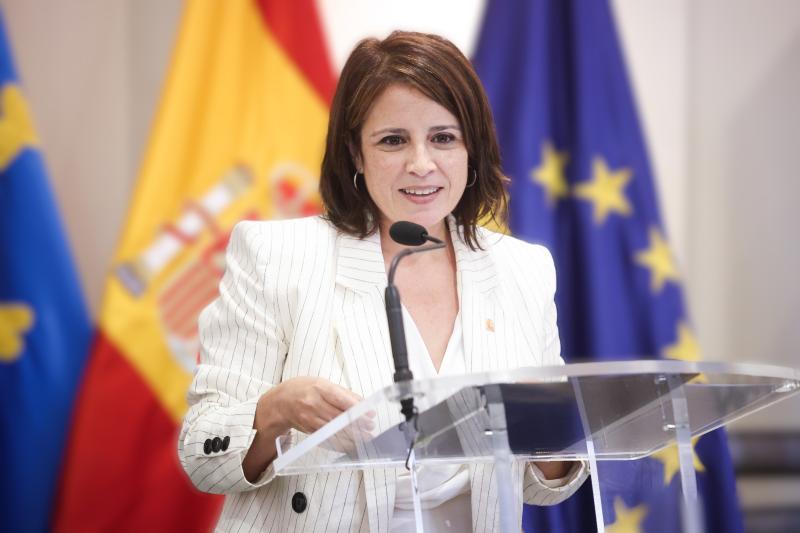
The Government delegate in Asturias, Adriana Lastra, has valued the data of the last accountability report, corresponding to the first half of the year, as a sample of the “solid and sustained progress of Asturias thanks to the commitment of the Government of Spain and the institutional collaboration with the Principality”.
According to Lastra, “the public policies implemented over the years have shown that you can grow cohesively, protect without cuts and modernize without leaving anyone behind.” The government delegate stresses that “Asturias is better than five years ago in employment, social protection, investment and future prospects”.
1,711 million of the Recovery Plan: an unprecedented investment in Asturias
The Recovery, Transformation and Resilience Plan has involved a total investment of 1,711 million euros in Asturias, of which 949 million correspond to calls and tenders managed by the General Administration of the State and 762 million have been allocated through sectoral conferences.
In total, 22,805 people, companies and institutions have already benefited from these funds.
The investments reach all the key areas for the future of the region: sustainable infrastructure, decarbonisation, digitalisation, housing, science, health, education or reindustrialisation.
Main projects promoted by the General Administration of the State:
- ADIF: 122 million euros for modernization of lines such as Gijón-Laviana and Pravian-Gijón.
- Roads: 105 million, with 72.6 million in the AP-66.
- Ports: 15.9 million for Gijón and Avilés.
- Low Emission Zones: 23.6 million in Oviedo, Gijón, Avilés and Siero.
- Renewables and energy: 145.4 million in PERTE ERHA projects, including green hydrogen, wind storage and repower.
- Energy rehabilitation and self-consumption: more than 80 million.
- Digitalization and connectivity: 29.5 million from the UNICO program for broadband, plus 16,000 digital kits to SMEs.
- Tourism and culture: more than 67 million for Tourism Sustainability Plans and restoration of historical heritage.
Autonomous execution:
- Sustainable mobility: 30.2 million for actions such as parking deterrents, walkways and pedestrian improvements.
- Autonomic TEPs: Asturias participates in key sectors such as the naval, agri-food, aerospace, social economy or digitization of water.
- Housing: 22.3 million to build 590 social rental homes and 28 million to rehabilitate neighbourhoods.
- Education and health: 2,820 new VET positions and 12.8 million for high health technology.
- Just transition: $17.6 million for projects in industrial and mining closure areas.
- Complementary R&D plans: 5.5 million in biodiversity, agri-food and hydrogen.
Strengthening employment and consolidating labour rights
Since June 2018, Asturias has added 29,624 more members to the Social Security, reaching a total of 393,659 employed. In addition, job stability is reflected in the 76,967 indefinite contracts signed so far this year, an increase of 175% compared to 2019.
“Faced with the catastrophic speeches of the right, the labor reform agreed with the social agents has had a structural impact on our labor market, favoring stability and protection against temporality,” explained Lastra.
Strengthening the welfare and protection status of families
The average pension in Asturias is 1,776 euros per month, 434 euros more than in 2018. The delegate recalled that, if the reform of the previous PP Government had been implemented, this average pension would barely reach 1,366 euros.
The Minimum Vital Income reaches 40,949 people in Asturias, with a cumulative total of 59,696 recipients since 2020, of these 22,110 would be minors. In addition, 43,189 people benefit from the electricity social bond, which guarantees access to energy to those who need it most.
In the educational field, 15,702 Asturian students have received scholarships, “ensuring that no young person can see their opportunities conditioned by their socioeconomic origin,” said Lastra.
Asturias in transformation: infrastructures, digitalization and ecological transition
The implementation of the Proximity Plan already exceeds 68% of the more than 1,060 million euros budgeted, and the Pajares variant is already fully operational. In addition, progress is being made in the modernization of tunnels, the improvement of road safety and the urban integration of railway infrastructures, such as the project of the intermodal station of Gijón.
With regard to the environment, the Government is still committed to a fair transition in Asturias, with investments aimed at the reconversion of mining areas, the circular economy and climate adaptation. “La Asturias post carbón empieza a ser una realidad”, ha afirmado la delegada.
Commitment to equality and territorial cohesion
Asturias has received 4.1 million euros this year from the Co-responsible Plan, another four million from the State Pact against Gender Violence, and an additional 700,000 euros for autonomous victim care programs.
“Real equality, conciliation and the fight against male violence remain priority axes of action for this Government,” said Lastra.
The delegate of the Government has concluded that “Asturias advances when there is a Spanish Government that believes in this land, that invests in its people and that accompanies its great transformations”. Lastra “Asturias feels good about this government because, together, we are building a stronger, fairer and more forward-looking autonomous community”.